Home Page » What is SCADA
What is SCADA System
The word SCADA stands for “Supervisory Control and Data Acquisition”. This definition already communicates its functionality and purpose.
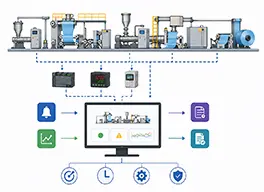
Each SCADA system is generally composed of the following elements:
One or more interconnected machines functioning as the human-machine interface and handling the supervision aspect
A series of peripheral devices (RTUs, I/O Modules, PLCs) employing sensors and actuators to communicate directly with the processes (machinery, plants, etc.)
A communication network ensuring proper data exchange within the system, through a variety of media and protocols.
SCADA software refers to an integrated development environment providing all the necessary tools to design SCADA applications running on monitoring devices. These applications must be able to fulfill all the purposes of a SCADA system: supervision, control, and data acquisition.
Supervision
Supervision should allow the operator to monitor the state of a process and to track its evolution in time by analyzing the state succession.
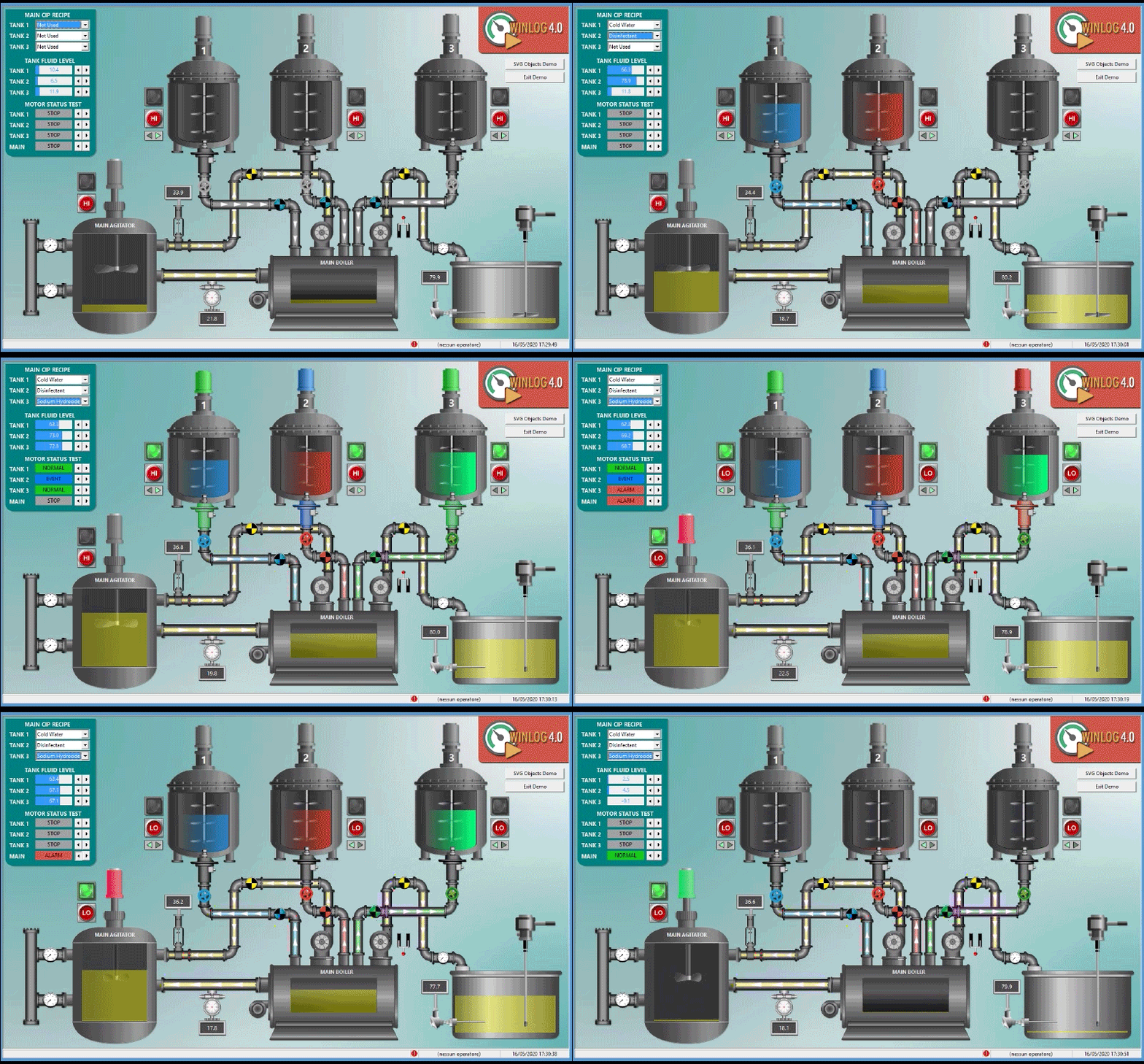
In practice, supervision happens through a human-machine interface (HMI) whose effectiveness depends on its ability to provide a clear and immediate representation of the process, its progression and the anomalies in the expected behavior.
As a result, the way information is visualized becomes critical, as the process state data must be delivered to the human operator with clarity and precision.
For example, a change in state of a pump can be represented by an icon changing color, the pressure values over time can be visualized with a graph, and an alarm being triggered can be shown in a pop up window.
Control
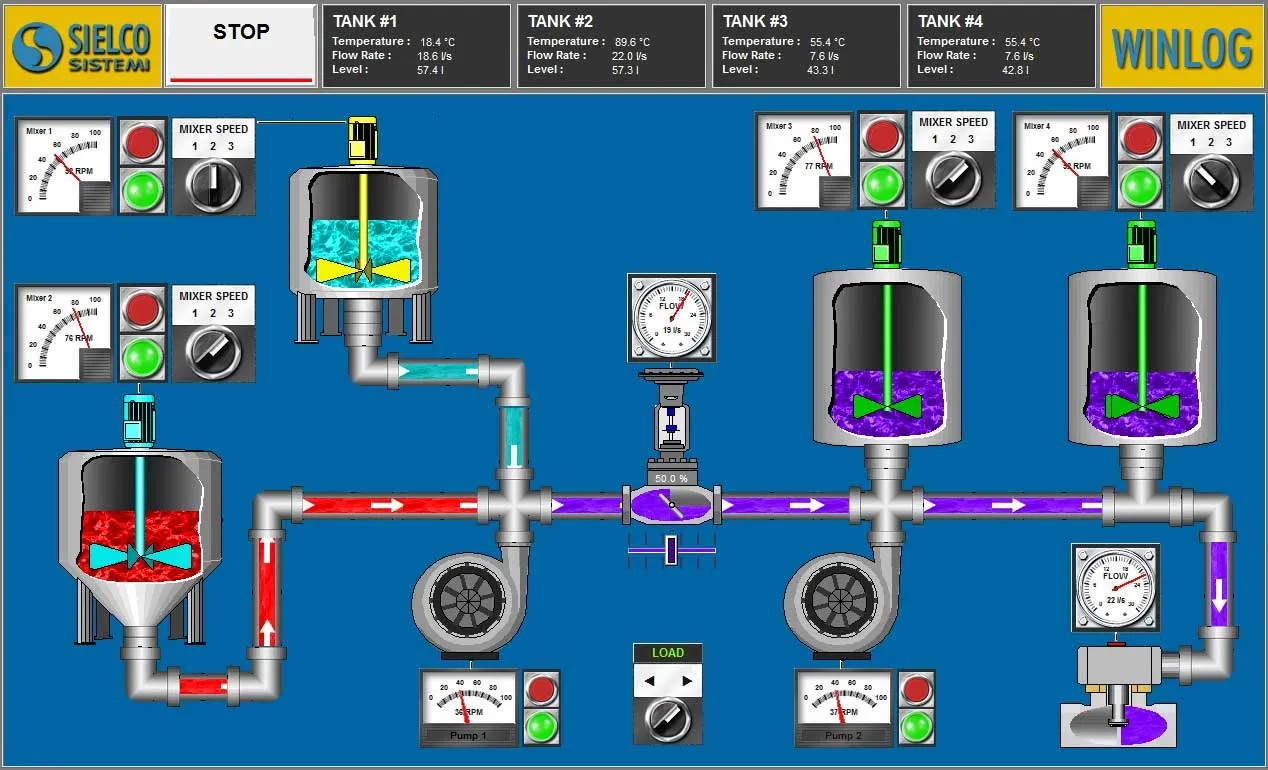
The control function of a SCADA system provides the operator with the ability to influence the processes, either manually or through pre-programmed behaviors.
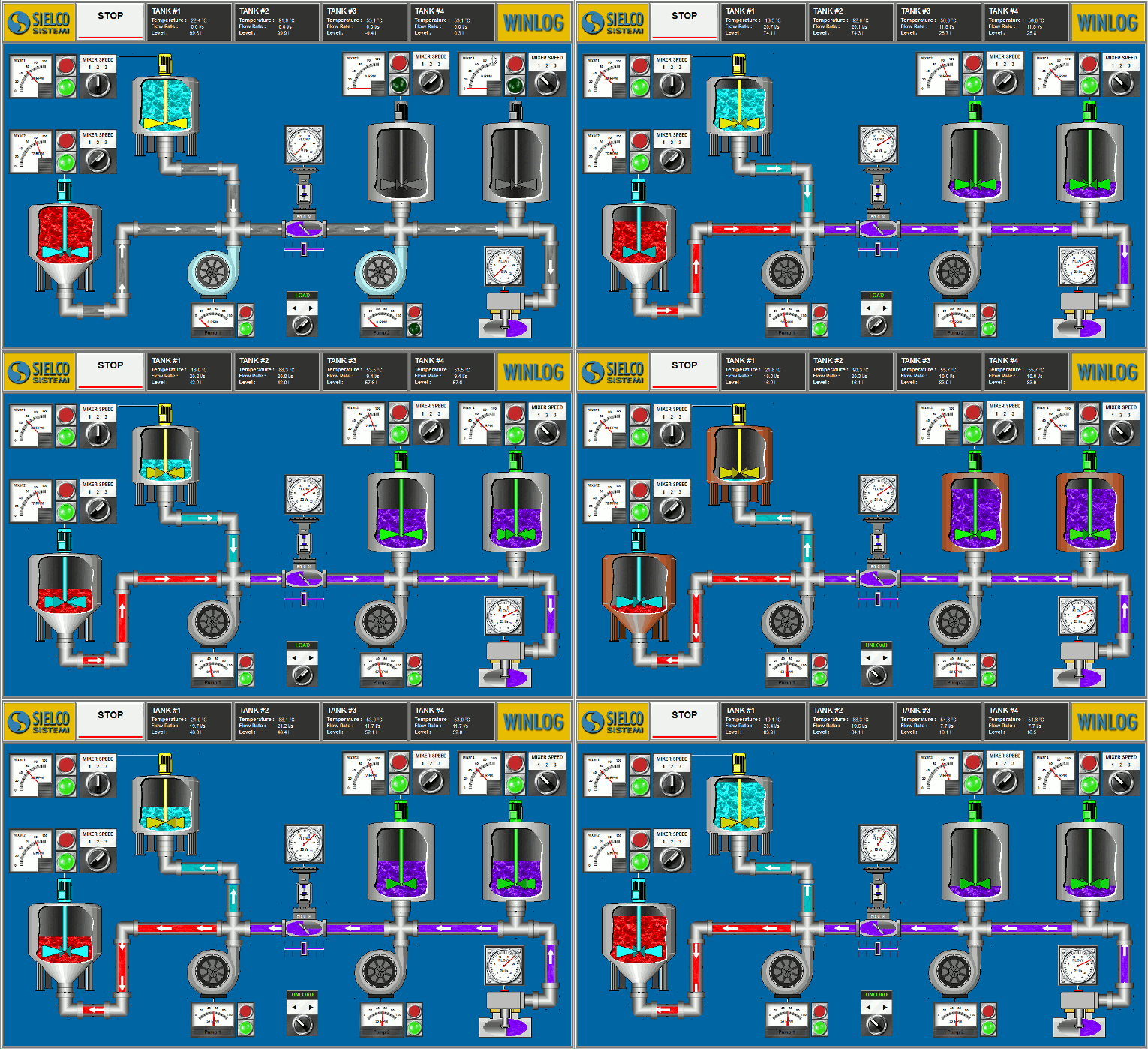
It is important to note that a SCADA system does not perform real-time control of a process, which is instead handled by the PLC controllers. In this context, control refers to the intentional modification of the process behavior; for example, a different production recipe can be sent to the process.
As a more practical example, we can imagine a process that needs a specific temperature range; the real-time control layer operates the actuators to maintain the temperature, while the SCADA system determines the desired setpoint, which could be taken from operator input, a recipe, or even calculated by the program from other variables.
Data Acquisition
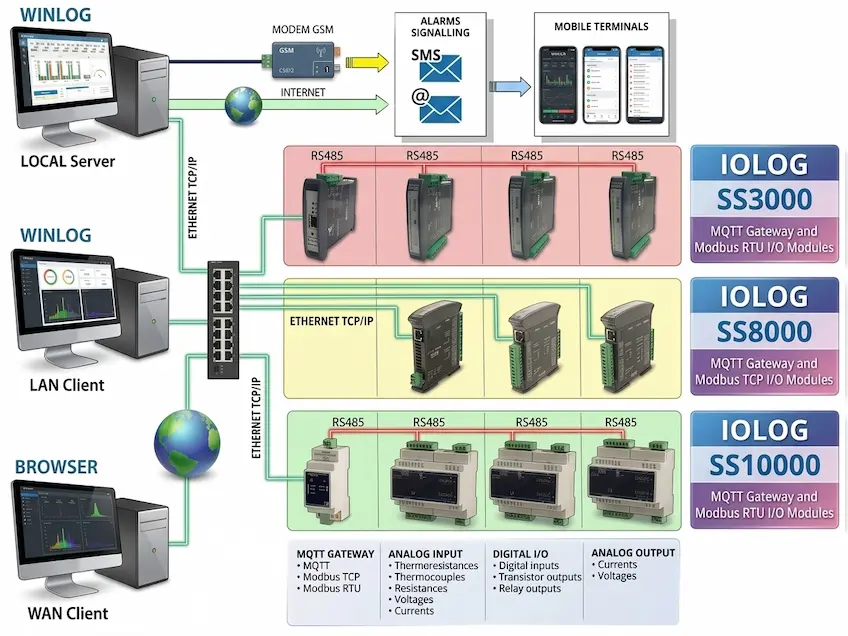
Data acquisition refers to the transfer of information between the peripheral devices and the supervision machine; it is worth noting that communication happens both ways, as process control requires commands to be transmitted to the process in addition to process data being collected.
Data acquisition is usually considered the primary function of a SCADA system, as it establishes communication between the process and the supervisory system, providing the information required for process monitoring and enabling supervisory control.
The purpose of data acquisition is to guarantee reliable and accurate information transfer between the process and the supervisory system in an environment characterized by multiple different media and transmission protocols simultaneously.
What is SCADA Software
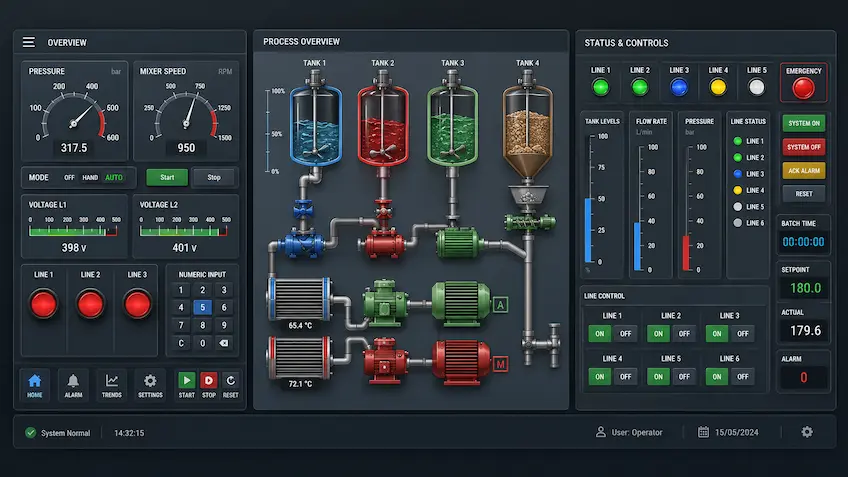
SCADA software is the development environment used to create supervisory HMI/SCADA applications. There are different kinds of SCADA software, by different manufacturers, with different price ranges and different capabilities. All SCADA software, regardless of complexity, presents the same core features: communication, human-machine interface, process information, reports and architecture.
The communication functions are achieved by development tools and driver libraries for exchanging data with industrial devices (PLCs, controllers, meters, etc.) from various manufacturers in the industrial automation sector. Data transfer happens through configurable variables, and is made possible by communication protocols such as OPC, Siemens, Omron, Allen Bradley, Modbus RTU, Modbus TCP, KNX, Bacnet, etc.
The human-machine interface consists of development tools and graphic libraries for the creation of static and animated synoptics. It is important to note that the way information is displayed is critical to the success of a SCADA application.
The process information modules provide development tools used to communicate the current state (online data) of the process and its progression (historical data) to the human operator. Two key components of this functionality are alarm handling and graphical trend representation of recorded variables over time.
The report functionalities provide development tools to record, organize and process data. This is achieved through the creation of report files intended for production review and quality control. Reports can describe a specific production lot, highlight its qualities, and verify its compliance with the given requirements.
The architecture aspect describes a set of tools and design principles to construct a complex system of interconnected applications. These applications must be able to communicate with each other through local (LAN) or public (Internet) networks and be accessible to multiple operators, both locally and remotely via a web browser.
Advantages of SCADA Software
SCADA applications are widely used across most industries and provide significant value to companies of all sizes, regardless of their industry sector. Simple and intuitive, SCADA software is designed to be the ideal development environment for building complex SCADA applications.
SCADA applications bring many advantages; among these, they can increase productivity by performing repetitive, monotonous tasks without the need for human intervention, react faster and more consistently to alarms and reduce environmental risks by enabling faster detection and response to abnormal operating conditions. More generally, SCADA systems provide the following key capabilities:
They provide a large amount of process information. All data acquired from sensors and real-time control devices (PLCs) is collected, stored, and further processed for quality control, efficiency diagnostics, and production optimization.
They offer a clear and intuitive plant overview. The human–machine interface (HMI) provides a graphical representation of the entire process, its progression and the anomalies in the expected behavior. This ensures that the process state data is delivered to the human operator with clarity and precision.
They scale easily and adapt as systems grow. The modular and flexible architecture of SCADA software allows it to adapt to changing requirements in expanding industrial environments and effectively respond to the challenges of a globalized market.
They offer centralized control of distributed systems. Many industrial systems, such as public utilities (water, electricity, etc.), are geographically distributed over large areas, traditionally requiring either permanent on-site personnel or periodic visits by maintenance technicians. SCADA applications enable remote supervision of field equipment and allow technical personnel to access system information wherever they are through any web browser.
Types of SCADA Software

The first distinction is given by the software platform:
A SCADA application can be built on a custom platform, developed specifically for a given machine or system. This software can be developed by the same company that provides the industrial machine or by a separate company based on the requirements specified by the client. While it is usually possible to configure parameters and process recipes, this applications are inherently limited by the impossibility to scale beyond the initially defined scope; this makes them unable to adapt to new conditions and requirements.
A SCADA application can also be built on an open platform designed for versatility. This gives the developer access to an integrated development environment which provides all the tools to implement all the required functionalities of the SCADA application (communication protocols, graphic libraries, etc.). This software is structured in two layers: the first level, shared among all users, is the SCADA platform; the second level, specific to the given machine or system, is the SCADA application designed by the user. Open platforms grant users the complete freedom to modify or expand the project in any way.
A SCADA system can consist of just one supervisory PC connected to the field devices. This is the most common option, but not necessarily the least complex. A single application system can be used to monitor multiple different plants, sometimes over great distances or distributed across vast geographical areas; complexity also depends on the amount of variables the system operates on, up to tens of thousands, the number of field devices connected to the machine, the different communication protocols employed. The simplest possible configuration consists of a single PC connected to a single machine, often through a single PLC; this is referred to as SCADA-HMI.
A SCADA system can also consist of multiple interconnected PCs; these can interact through local (LAN) or public (Internet) networks, organized in a multi-level hierarchy. The most common architecture features a single central PC, with multiple second-level PCs connected to it; second-level PCs can be organized by geographical requirements (each PC referring to a different area) or functional needs (each PC is assigned a different purpose); the main PC provides access to all the system data from a centralized location.
Finally, the third distinction is given by the real-time requirements:
Classic SCADA system do not have any specific real-time requirements. Their main purpose is process data acquisition, state summary, alarm handling, information collection and report generation for production review and quality control. Data exchange from the application to the machine is restricted to system configuration and recipe injection; when performing process control, delays of over one second are considered acceptable.
Other SCADA systems necessitate narrower real-time constraints. Systems with these requirements usually consist of several microcontrollers connected to a supervisory PC through a local network; these systems rely on deterministic operation with calculated response intervals with millisecond-level precision. These are more properly referred to as DCS systems, and, due to their prohibitive costs, their use is usually only justified by large-scale industrial facilities that require high levels of precision, reliability and security.
Choice of SCADA Software
Many factors influence the choice of SCADA software, including personal preference, complexity of the application, required features, available budget and client-imposed constraints. Another relevant aspect is the time required to learn the software, which scales with the complexity of the SCADA software. The use of a more complex software is usually justified when dealing with large and complex industrial systems whose cost exceeds that of even the most expensive SCADA software by several orders of magnitude, rendering license costs and development time largely irrelevant. For smaller, less costly systems, a simpler, more affordable SCADA software with lower training requirements is often the preferred choice. Assuming our project requires a fairly simple application, with a single PC connected to many devices and without precise real-time requirements, we need to consider the following:
Project size: the first aspect to consider is the number of required variables (tag) that need to be shared with the external devices. The license choice, the response times of the system and the development time all depend on the number of tags.
Field device compatibility: it is vital to verify that the SCADA software provides all the communication protocols required by the field devices; alternatively, a compatible OPC Server can be installed on the supervisory PC. An OPC Server acts as an intermediary between the SCADA application and field devices, exposing their data through the standard OPC interface.
Integration with other software: if the application must interface with other enterprise software such as MES or ERP, this capability should be verified. This is typically achieved using OPC UA Client/Server protocols.
Browser accessibility: if the application needs to be remotely accessed via web on desktop or mobile, this capability should be verified.
External DBMS compatibility: if the application must interface with an external DBMS (MySQL, …) for the purposes of recording data (datalogger function) or sending specific commands (API) to execute queries (SELECT, INSERT, UPDATE, …), this capability should be verified.
Remote maintenance: if the application must provide an interface to configure remote devices (PLCs) without direct network access (e.g., fixed IP or DNS), this capability should be verified.
The choice of SCADA software and its license should always strike a balance between desired functionality and cost, as well as development and learning times. Sometimes the most powerful software isn’t the best solution, as some features might not be necessary. A software with fewer features could be cheaper, more reliable, less complex and easier to use. Fast and effective techincal support is an often overlooked aspect that greatly affects the end result and should be taken into consideration.
SCADA, IoT and Industry 4.0
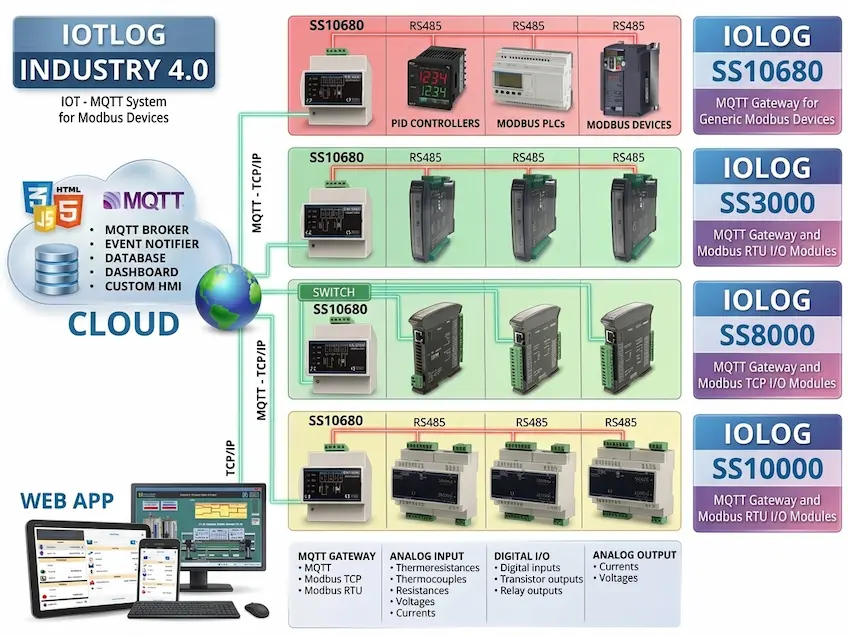
IoT (Internet of Things) and IIoT (Industrial Internet of Things) refer to any technology used to connect objects (sensors, actuators, vehicles, home automation modules, etc.) to the Internet and send their data to the cloud through lightweight communication protocols such as MQTT.
To meet the growing demand for cloud applications, SCADA systems have evolved to integrate and enhance Industrial Internet of Things. The combination of these two technologies has resulted in data collection of industrial processes becoming quicker, more precise and even more secure (cybersecurity).
Due of their architecture, these system are especially suited for:
remote maintenance, remote diagnosis and remote control
monitoring and control of the working conditions of the machines
energy and water consumption monitoring and emission reduction
quality control of the production system and its processes
These systems implement the key enabling technologies (KETs) of Industry 4.0 (SCADA, IoT, cloud, big data, cybersecurity) and are perfectly aligned with the guidelines set out in Italy’s National Industry 4.0 Plan, introduced under the 2017 Budget Law.
Examples of SCADA applications
The development of SCADA applications has its roots in the Industrial Automation field to address the need for centralized control stations to access all the industrial process information at once, with particular emphasis on ensuring the plant functions correctly through alarm management and maintenance.
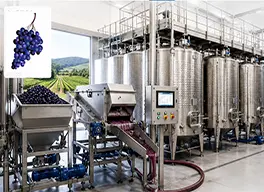
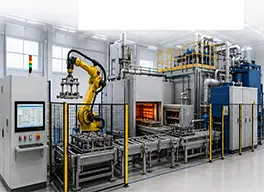
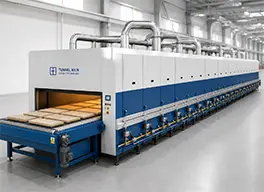
SCADA applications are used in almost every sector of Industrial Automation (plastic, wood, food, ceramics, textiles, packaging, etc.), optimizing the production process through the automation of several important tasks (quality control, regulation compliance, production efficiency, reports).
Soon afterwards, the use of SCADA software has expanded beyond Industrial Automation and into telecontrol of public utility networks (electrical, water, railways, etc.), Building Automation (building supervision) and even Home Automation (home supervision).
Listed below is a series of examples of SCADA applications: