SCADA protocols guide: Modbus, OPC UA and reliable communications
Sielco Sistemi —
A SCADA system is only as good as the data it can reliably collect, and that depends entirely on the communication protocols it supports. From decades-old serial links to modern IoT-oriented standards, SCADA protocols are the plumbing that connects PLCs, sensors and remote devices to the supervisory layer. This guide walks through the most important ones and explains how a platform such as Winlog Evo handles them in practice.
What are SCADA protocols
A SCADA protocol defines how data is structured, addressed and exchanged between field devices and the supervisory system: which bytes represent a register value, how a request is acknowledged, how errors are detected. Some protocols, like Modbus, are simple and deterministic, built for point-to-point or master-slave polling over serial lines or Ethernet. Others, like OPC UA, are richer, self-describing and platform-independent, designed to expose structured data models rather than raw registers. Choosing the right mix of protocols, and having software with broad, well-maintained driver support, is one of the most consequential decisions in a SCADA project.
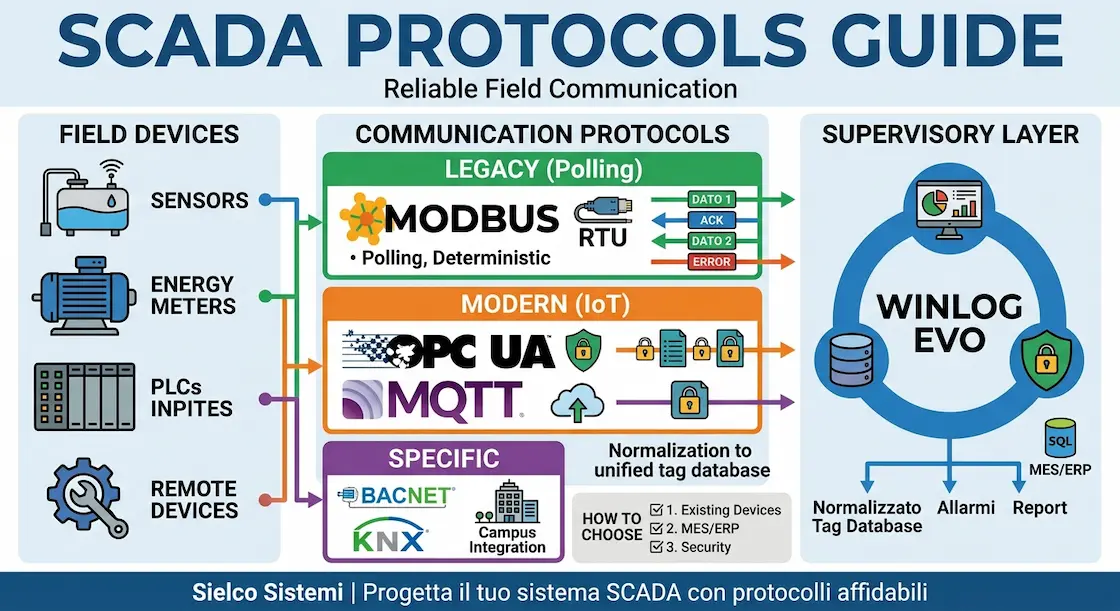
Most plants end up running several protocols side by side rather than a single one: an older Modbus RTU line for legacy instruments, OPC UA for newer PLCs and MES integration, and perhaps MQTT for a handful of IoT sensors added later. A SCADA platform’s job is to normalize all of this into a consistent tag database, so operators and reports never need to know which wire protocol a given value actually travelled over.
Modbus in SCADA: use cases
Modbus SCADA integrations remain extremely common because Modbus is simple, well documented and supported by almost every PLC, drive, meter and sensor built in the last three decades. Modbus RTU (serial) is typical for legacy field devices and long cable runs where Ethernet is impractical, while Modbus TCP is the default choice for newer installations on a plant Ethernet network. Because Modbus has no built-in security and limited data typing, it works best inside a trusted, segmented network, with the SCADA platform handling scaling, alarming and historization on top of the raw register values it reads.
Typical Modbus use cases include polling energy meters and flow meters, reading status and fault words from variable-frequency drives, and exchanging setpoints with simple PLCs that do not support richer protocols. Its predictable, well-understood behavior also makes Modbus a popular fallback protocol even in otherwise modern architectures, since almost any integrator or vendor can troubleshoot it quickly.
Modern, practical SCADA protocols
Beyond Modbus, a set of modern, practical SCADA protocols has emerged to address integration, security and IoT use cases. OPC UA adds built-in security, structured data modeling and platform independence, making it the preferred choice for integrating PLCs, DCS and MES/ERP systems. For building automation, BACnet and KNX are the dominant standards. For lightweight IoT and edge scenarios, MQTT has become the protocol of choice thanks to its publish-subscribe model and low bandwidth footprint, an approach increasingly promoted by industrial IoT standardization efforts such as the Industrial Internet Consortium. A well-built SCADA platform supports all of these natively rather than forcing a single protocol choice across a heterogeneous plant.
These newer protocols share a common thread: they were designed with cybersecurity and scalability in mind from the start, unlike many legacy industrial protocols. Migrating toward OPC UA and MQTT where practical, while keeping Modbus for the devices that require it, is usually the most realistic path for plants modernizing incrementally rather than replacing everything at once.
How to choose the protocol
Start from the devices you already have: legacy PLCs and instruments often only speak Modbus or a vendor-specific serial protocol, which immediately narrows the practical choice. For new installations or integrations with MES/ERP systems, OPC UA is usually worth the extra engineering effort thanks to its security and structured data model. For building or campus-level projects, follow the BACnet/KNX convention already used by the HVAC and electrical contractors involved. Finally, check the device support list of your SCADA platform before committing to hardware, since protocol compatibility is far easier to plan for upfront than to retrofit later.
It also helps to think in terms of total cost rather than protocol elegance alone: a platform with a large native driver library, like Winlog Evo, can absorb protocol diversity without custom development, which usually matters more to the project timeline than picking the theoretically "best" single protocol.
Want to check protocol compatibility for your own devices? Browse the supported communication drivers, try the Winlog Evo web demo, or contact Sielco Sistemi for guidance.
FAQ
- What is the most common SCADA protocol?
- Modbus is the most widely used SCADA protocol, thanks to its simplicity and support across almost every PLC, drive, meter and sensor built in the last three decades, in both RTU (serial) and TCP (Ethernet) variants.
- What is the difference between Modbus and OPC UA?
- Modbus is a simple, deterministic protocol that exchanges raw register values with no built-in security. OPC UA is richer and self-describing, exposing structured data models with built-in security, which makes it better suited for integrating PLCs, DCS and MES/ERP systems.
- When should I use MQTT instead of Modbus or OPC UA?
- MQTT is best for lightweight IoT and edge scenarios with many low-bandwidth sensors and intermittent connectivity, thanks to its publish-subscribe model. Modbus and OPC UA remain preferable for direct, high-reliability communication with PLCs and DCS.
- Is Modbus secure enough for a SCADA network?
- Modbus has no built-in authentication or encryption, so it should only be used inside a trusted, segmented network, with the SCADA platform and network architecture providing the security layer that the protocol itself lacks.
- How do I choose the right protocol for a new SCADA project?
- Start from the devices you already have, since legacy equipment often narrows the choice to Modbus. For new installations or ERP/MES integration, prioritize OPC UA; for buildings, follow BACnet/KNX; and always check your SCADA platform’s device support list before committing to hardware.