SCADA for photovoltaic plants: solar monitoring, alarms and reporting
Sielco Sistemi —
A photovoltaic power plant, whether a rooftop array or a utility-scale solar farm, only delivers its full value when its output is visible, verifiable and actionable in real time. A dedicated photovoltaic SCADA system collects data from inverters, meters, weather stations and trackers, turning scattered field signals into a single supervisory view of the plant. This is where SCADA for energy applications differ from generic industrial monitoring: uptime translates directly into revenue, and every hour of undetected downtime is lost production. Winlog Evo is a SCADA platform built to cover exactly this need, from a single plant to distributed portfolios.
Photovoltaic monitoring and data
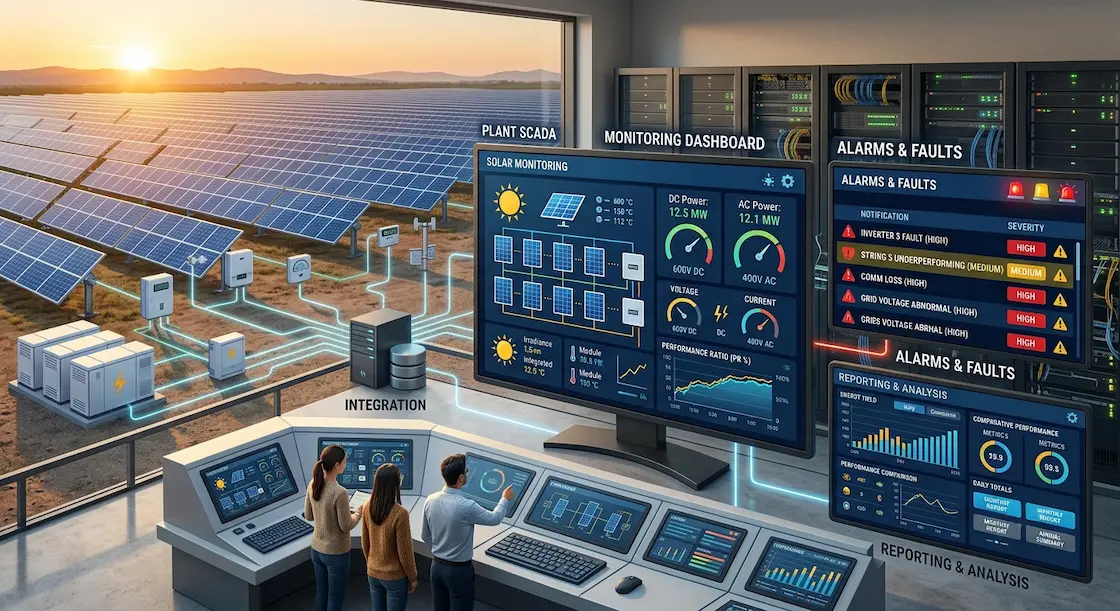
A photovoltaic plant SCADA continuously polls string inverters, central inverters, combiner boxes and smart meters to build a live picture of DC and AC power, voltage, current, energy yield and grid export at every level of the installation, from individual strings up to the plant boundary. Overlaying this electrical data with environmental readings from pyranometers, weather stations and module-temperature sensors lets operators separate genuine equipment underperformance from expected variation caused by irradiance, cloud cover or ambient temperature. This combination of electrical and meteorological data is the foundation of accurate solar SCADA analysis, and it is what makes it possible to compare actual output against a theoretical expected curve rather than against a fixed target.
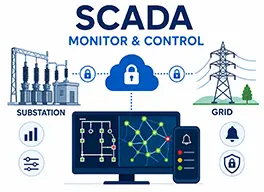
Because photovoltaic assets are often unmanned and geographically dispersed, remote accessibility matters as much as data accuracy: an engineer should be able to check any string, inverter or weather station from a central control room without a site visit. A platform such as Winlog Evo consolidates this data historically in a SQL database, so trends spanning weeks or seasons remain available for later analysis rather than being lost once a shift ends.
Alarms and maintenance for photovoltaic plants
Timely fault detection is what protects a plant’s energy yield from silent losses. SCADA software for solar power plant operation should raise alarms not only for hard failures — a tripped inverter, a lost communication link, a grid fault — but also for soft underperformance, such as a string producing measurably less than comparable strings under the same irradiance. String-level comparison is particularly effective at catching issues like soiling, shading, connector degradation or a failed bypass diode long before they would show up as a full outage. Alarm priorities and escalation rules, following practices similar to those recommended by the International Society of Automation, ensure that a critical inverter fault reaches the responsible technician immediately, while minor deviations are logged for the next scheduled review.
This alarm data feeds directly into maintenance planning: correlating fault frequency and downtime by inverter, string or site helps prioritize preventive maintenance where it has the greatest financial impact, and a searchable event history supports both internal root-cause analysis and any warranty or insurance claim that depends on documented evidence of an anomaly.
Production dashboards and reports
Asset owners, O&M teams and financial stakeholders each need a different view of the same underlying data, and dashboards are how a SCADA system serves all three without duplicating infrastructure. A production dashboard typically surfaces instantaneous power, daily and cumulative energy yield, and Performance Ratio — the industry-standard metric, defined by international bodies such as the International Energy Agency, that expresses actual output as a share of the theoretical maximum for the available irradiance. Reports generated automatically from the same SQL history support monthly production statements, availability calculations for O&M contracts, and revenue reconciliation against energy sold to the grid.
Because reporting draws on structured historical data rather than manual logs, comparisons across plants, inverters or time periods become straightforward, and irregularities that would be invisible in daily readings — a slow seasonal decline in one plant relative to its peers, for instance — become easy to spot once aggregated in a report or exported for further analysis.
Integration of field systems
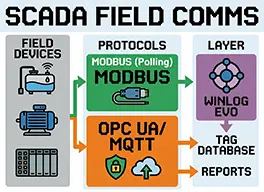
Solar assets rarely use a single equipment brand: a plant may combine inverters, weather stations, trackers, meters and battery storage from different manufacturers, each speaking its own protocol. Solar SCADA monitoring depends on broad, reliable connectivity to all of them, which is why the range of supported communication drivers is one of the most important criteria when choosing a platform. Winlog Evo supports Modbus TCP/RTU, OPC UA and a wide catalogue of manufacturer-specific device drivers, allowing inverters and sensors from different vendors to be brought into a single supervisory system without custom middleware.
This same integration layer also connects photovoltaic monitoring to the wider site: grid-interface protection relays, energy storage controllers and, where applicable, building or industrial process systems, so that solar generation is managed as part of the overall energy strategy rather than as an isolated silo.
See these capabilities in action with the Winlog Evo web demo, check the full list of supported communication drivers, or contact Sielco Sistemi to request a demo tailored to your photovoltaic plant.
FAQ
- What data does a photovoltaic SCADA system collect from a solar plant?
- It polls inverters, meters, weather stations and trackers to gather DC/AC power, voltage, current, energy yield and grid export, and overlays this with irradiance and temperature readings to distinguish real underperformance from expected weather-driven variation.
- How does SCADA help detect faults and plan maintenance in photovoltaic plants?
- It raises alarms for both hard failures and soft underperformance, such as a string producing less than comparable strings, and correlating fault frequency and downtime by inverter, string or site helps prioritize preventive maintenance where it matters most.
- What is Performance Ratio and how do SCADA reports use it?
- Performance Ratio is an industry-standard metric that expresses actual energy output as a share of the theoretical maximum for the available irradiance; SCADA reports built on historical SQL data use it to support monthly production statements and O&M availability calculations.
- Which field devices can be integrated into a photovoltaic plant SCADA?
- String and central inverters, weather stations, trackers, smart meters and battery storage controllers from different manufacturers can all be integrated through protocols such as Modbus TCP/RTU and OPC UA together with manufacturer-specific device drivers.
- Can one SCADA system supervise multiple photovoltaic plants at different sites?
- Yes: a platform built for distributed portfolios consolidates data from multiple remote, often unmanned plants into a single supervisory view and central SQL history, so engineers can compare, monitor and manage them from one control room.