SCADA for electrical grids and substations: remote monitoring and control
Sielco Sistemi —
Electrical grids and substations sit at the heart of the energy sector, converting, transforming and distributing power across vast networks of lines, transformers, switchgear and protection relays. Supervising this infrastructure calls for a dedicated electrical substation SCADA system able to collect measurements, states and alarms from countless remote devices and present them as a single, coherent operational picture. Winlog Evo, the SCADA/HMI platform developed by Sielco Sistemi, is a concrete example of how such supervisory systems are built, deployed and secured for utilities and industrial power users who cannot afford blind spots in their electrical network.
Electrical SCADA: meaning and benefits
Understanding the meaning of SCADA in electrical systems starts with the acronym itself: Supervisory Control And Data Acquisition. In the electrical sector this translates into a software layer that polls remote terminal units, protection relays and meters installed on lines, transformers and switchgear, then turns raw readings into synoptic diagrams, trends and reports that operators can act on from a control room. Rather than sending crews to inspect every pole or cabinet, a well designed SCADA system brings the whole network to the desktop, cutting response times and operating costs.
The benefits of SCADA for electrical systems go beyond simple visualization. Centralised supervision improves load balancing, supports faster fault isolation, and gives planning engineers the historical data needed to size future investments. Because electrical assets are frequently scattered across wide territories and supplied by multiple vendors, a platform such as Winlog Evo earns its keep through an open architecture and a broad library of communication drivers, letting utilities integrate legacy relays alongside modern devices without ripping out working equipment.
Monitoring power supply grids
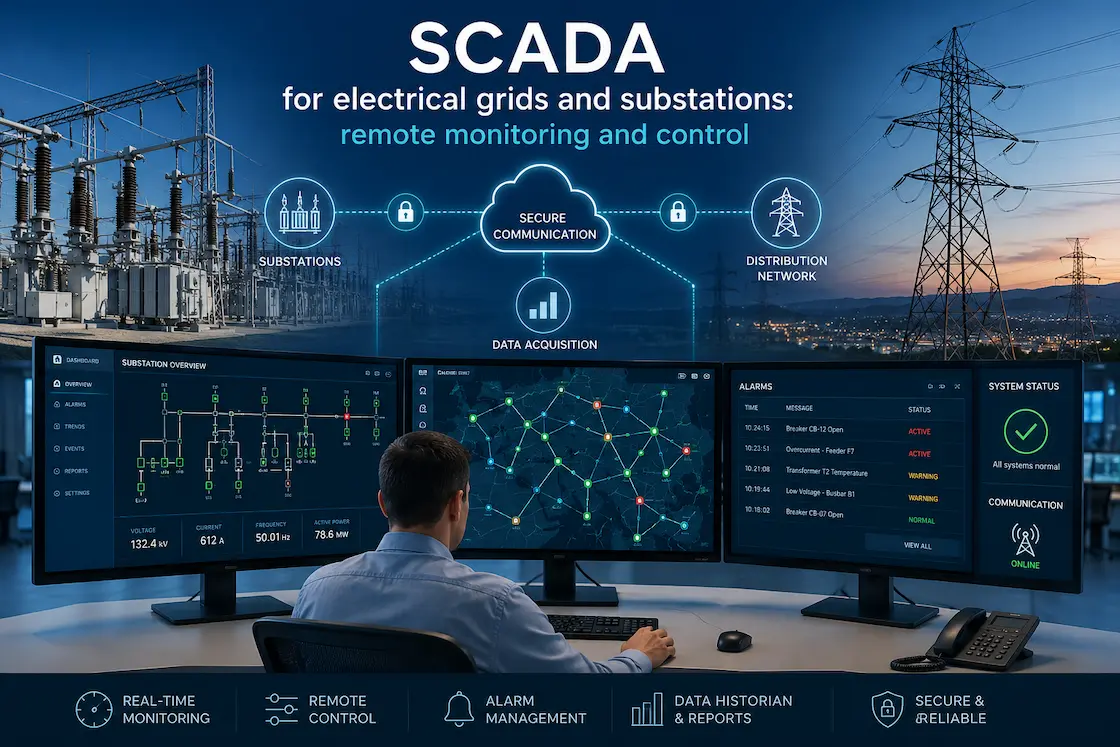
Electrical substation SCADA is where this supervision becomes tangible: circuit breakers, disconnectors, transformers and protection relays inside a substation are continuously polled, their status displayed on synoptic mimics that mirror the actual switchyard layout, so an operator can tell at a glance whether a feeder is energised or a breaker has tripped. Extending this view across an entire substation network, and then across the whole distribution and transmission grid, is what turns isolated monitoring into genuine SCADA in power supply systems, where every site reports into the same control room and the same historian.
Winlog Evo supports this scale-out through drivers for the protocols most common on utility networks, from Modbus to DNP3 and IEC 60870-5-104, and through remote I/O and RTU connectivity that keeps rural or unmanned sites in the same operational picture as major substations. As power grids evolve toward a smart grid model with distributed generation and variable loads, this kind of continuous, wide-area monitoring becomes essential for balancing supply and demand and for anticipating congestion before it causes an outage.
Alarms, events and history
Every electrical SCADA deployment lives or dies by how well it handles alarms: an overload, an unexpected breaker trip or a voltage excursion outside limits must reach the operator within seconds, prioritised so that a critical transformer fault is never buried under a flood of minor notifications. Winlog Evo generates alarms directly from real-time values and digital statuses, applying configurable thresholds and hysteresis so that operators are notified reliably without being overwhelmed by nuisance alarms caused by normal switching operations.
Alongside alarms, every event on the network — a manual switching operation, a protection relay pickup, a communication loss with a remote substation — is timestamped and written to a standard SQL historian. This persistent record turns a live monitoring tool into a source of engineering evidence: post-incident analysis, regulatory reporting and long-term reliability studies all depend on being able to query exactly what happened, in what sequence, across weeks or years of operation. Because the data sits in an open SQL database rather than a proprietary log, it can also be cross-referenced with maintenance records or exported for further analysis outside the SCADA system itself.
Reliability and operational security
Electrical infrastructure is classified as critical infrastructure in most countries, so the SCADA system supervising it must be as dependable as the grid it watches. Redundant servers, resilient communication paths to remote substations and graceful degradation when a link drops are baseline requirements, since losing visibility over even one substation can mask a developing fault until it becomes an outage. Reliability guidance from bodies such as NIST and CISA treats availability and cybersecurity as inseparable: an electrical SCADA platform that is easy to compromise is, in practice, not reliable at all.
Winlog Evo addresses this pairing with role-based access control, full audit trails of operator actions, and SecureBridge for encrypted, authenticated remote connections to substations and grid sites, so engineers can diagnose or reconfigure equipment remotely without exposing protection relays and RTUs directly to the internet. Combined with segmented networks and regular patching practices recommended by the same guidance, this keeps both the operational reliability and the security posture of the electrical network at the level that utilities and industrial operators require.
Want to see how remote monitoring and control of an electrical network looks in practice? Try the Winlog Evo web demo, explore the available communication drivers, or contact Sielco Sistemi to discuss your grid or substation project.
FAQ
- What is the meaning of SCADA in electrical systems?
- SCADA stands for Supervisory Control And Data Acquisition. In electrical systems it is a software layer that polls remote terminal units, protection relays and meters on lines, transformers and switchgear, turning raw readings into synoptic diagrams, trends and reports operators can act on from a control room.
- What does electrical substation SCADA actually monitor?
- It continuously polls circuit breakers, disconnectors, transformers and protection relays inside a substation and displays their status on synoptic mimics that mirror the actual switchyard layout, so an operator can tell at a glance whether a feeder is energised or a breaker has tripped.
- How does a SCADA system prioritize alarms on an electrical network?
- It generates alarms directly from real-time values and digital statuses, applying configurable thresholds and hysteresis so critical faults such as an overload or an unexpected breaker trip reach operators within seconds without being buried under a flood of minor notifications.
- Why store electrical grid events in a SQL historian?
- Because every timestamped event, from a manual switching operation to a communication loss with a remote substation, becomes queryable engineering evidence: post-incident analysis, regulatory reporting and long-term reliability studies all depend on reconstructing exactly what happened and in what order.
- How can engineers reach remote substations securely?
- Through tools such as Winlog Evo SecureBridge, which establishes encrypted, authenticated remote connections to substations and grid sites without exposing protection relays and RTUs directly to the internet, preserving the access controls and traceability expected on site.