SCADA for HVAC and building management: BMS, supervision and energy control
Sielco Sistemi —
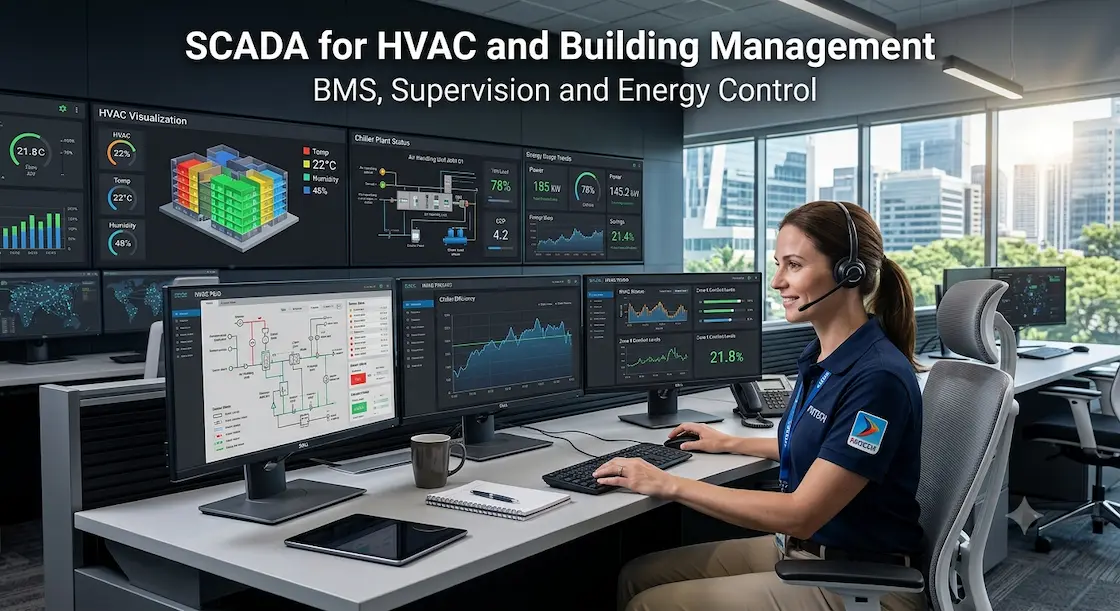
Chillers, air handling units, boilers, pumps, dampers and building-wide energy meters all need to be monitored, controlled and logged just as carefully as a production line. HVAC SCADA extends the same supervisory architecture used for industrial plants and infrastructure to heating, ventilation and air conditioning systems, giving facility teams real-time visibility, alarms and historical trends instead of a collection of disconnected local controllers. Winlog Evo, the SCADA/HMI platform from Sielco Sistemi, brings this level of supervision to HVAC and building automation projects, from a single air handling unit to multi-building energy programs.
HVAC SCADA: what it includes
An HVAC SCADA deployment typically supervises chillers, boilers, air handling units, cooling towers, variable-frequency drives, dampers, valves and zone controllers, pulling real-time values and status from each device into a single set of synoptic screens. Rather than relying on isolated local controllers that only display a single machine’s state, the SCADA layer aggregates every plant across a building or campus, correlates them on live mimics, and stores every measurement in a historian for later analysis. Connectivity is what makes this possible: field devices typically expose data over BACnet, Modbus or KNX, and a platform with broad communication driver coverage can poll chillers, meters and building controllers side by side without custom integration work for each brand.
Beyond live supervision, HVAC SCADA typically adds scheduling, setpoint management, trend graphs comparing supply and return temperatures, and role-based access so operators, maintenance staff and energy managers each see the views relevant to their job. This turns a set of mechanical rooms scattered across a site into one coherent, searchable operational picture.
BMS vs SCADA: differences
The question of BMS vs SCADA comes up on almost every building automation project, because the two overlap in purpose but not in scope. A Building Management System is purpose-built for a single building or campus, focused on HVAC, lighting, access control and life-safety, usually speaking a narrow set of standardized protocols such as BACnet or KNX. A SCADA platform, by contrast, was designed to supervise industrial processes and distributed infrastructure at much larger scale, with deeper historization, alarm management and reporting, and support for a wider variety of protocols.
BMS SCADA convergence happens naturally on sites where facility management and process supervision must share the same data: a factory with an adjoining office wing, a hospital campus, or a food plant where energy reporting has to cover both production equipment and air handling units. In these cases, a SCADA platform with native building protocol support can absorb BMS-style supervision into the same supervisory layer used for the industrial process, avoiding the cost and friction of running two disconnected systems side by side.
Energy monitoring software (consumption) and comfort control
Energy monitoring software built on a SCADA foundation tracks consumption at the meter, sub-meter and equipment level, breaking down electricity, gas, water and thermal energy use by building, floor or plant so that inefficiencies and anomalies stand out rather than being buried in a single utility bill. Dashboards and periodic reports typically compare consumption against production, occupancy or weather data, which lets energy managers separate genuine waste from seasonal variation and justify retrofit investments with real numbers rather than estimates.
Comfort control is the other half of the equation: temperature, humidity and air quality setpoints need to track occupancy schedules and outdoor conditions without wasting energy overnight or on weekends when a space is empty. A SCADA supervisory layer lets facility managers adjust setpoints and schedules centrally, apply the same logic across dozens of zones at once, and generate the consumption reports that regulators and sustainability programs increasingly require, all from the same interface used to watch the plant in real time.
Alarms and maintenance for plants
Mechanical plant failures rarely happen without warning signs, but those signs are easy to miss without a supervisory system watching continuously. A well-configured alarm strategy flags abnormal temperatures, pressure deviations, filter clogging, compressor cycling and communication loss the moment they occur, routing notifications to the right maintenance team by email, SMS or on-screen alert so problems are addressed before they become outages or comfort complaints. Historized alarm and event logs also make it possible to review recurring faults and spot patterns that point to a failing component before it fails completely.
That same historical data feeds predictive and preventive maintenance: run-hour counters on pumps and fans, filter change reminders, and trend analysis on energy draw per unit of output all help maintenance teams move from reacting to breakdowns to scheduling work around actual equipment condition. Combined with the alarm layer, this turns the SCADA system into the operational backbone for both day-to-day plant reliability and longer-term maintenance planning.
Ready to see HVAC and building supervision in action? Try the Winlog Evo web demo, review the supported communication drivers, or contact Sielco Sistemi to discuss your building or plant.
FAQ
- What does an HVAC SCADA system typically supervise?
- It supervises chillers, boilers, air handling units, cooling towers, variable-frequency drives, dampers, valves and zone controllers, aggregating real-time values from each device into synoptic screens and a historian instead of isolated local controllers.
- What is the main difference between BMS and SCADA?
- A BMS is purpose-built for a single building, focused on HVAC, lighting, access control and life-safety with narrow standardized protocols like BACnet or KNX, while SCADA supervises industrial processes and distributed infrastructure at larger scale, with deeper historization and reporting.
- How does energy monitoring software help reduce building consumption?
- It tracks consumption at the meter, sub-meter and equipment level and compares it against production, occupancy or weather data, so inefficiencies stand out instead of being buried in a single utility bill, letting managers target real waste and justify retrofits with real numbers.
- How is comfort control managed within a SCADA/BMS platform?
- Temperature, humidity and air quality setpoints track occupancy schedules and outdoor conditions to avoid wasting energy when spaces are empty; a SCADA supervisory layer lets facility managers adjust setpoints and schedules centrally across dozens of zones from one interface.
- How does the alarm system support predictive maintenance for HVAC plants?
- Alarms flag abnormal temperatures, pressure deviations, filter clogging and communication loss as they occur, while historized alarm and event logs reveal recurring faults; combined with run-hour counters and trend analysis, this shifts maintenance from reactive repairs to condition-based planning.