Railway SCADA systems for railway infrastructure and plants
Sielco Sistemi —
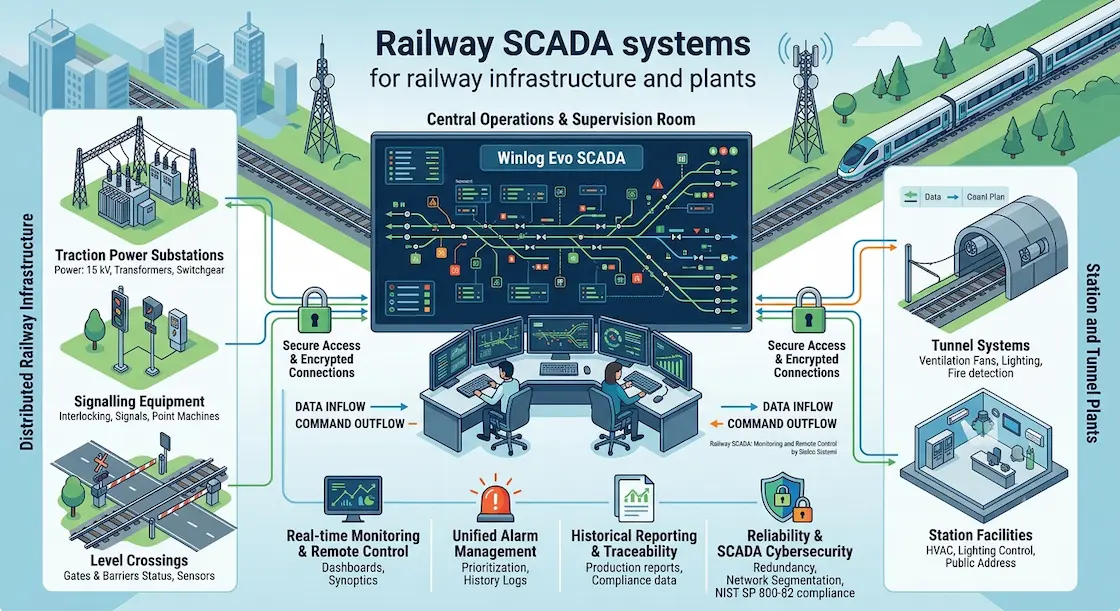
Railway networks combine traction power substations, signalling equipment, level crossings, tunnels, lighting and station plants spread across hundreds of kilometres, all of which need to be watched and coordinated from a single point of view. SCADA for transportation is exactly this: a supervisory layer that collects data from remote terminal units, PLCs and field sensors along the line and turns it into live dashboards, alarms and historical reports. Winlog Evo, the SCADA/HMI platform from Sielco Sistemi, is a reference example of how such systems are designed, deployed and secured in demanding rail environments.
Railway plant monitoring
Effective railway plant monitoring means bringing together data from traction power substations, points and switches, level crossing barriers, tunnel ventilation, station HVAC and lighting into one coherent operational picture. Instead of maintenance teams visiting each site to check status, a SCADA system polls field controllers continuously and renders their state on synoptic screens that mirror the physical layout of the line, so an operator can see at a glance which substation is loaded, which crossing barrier is down, or which tunnel fan has stopped. This is the foundation of what the industry increasingly calls SCADA railway supervision: a single software layer standing between scattered field equipment and the people responsible for keeping trains moving safely, in line with the operational principles promoted by bodies such as the International Union of Railways.
Because railway assets are inherently distributed, monitoring also has to account for very different equipment types and protocols on the same line — from legacy relay-based interlocking to modern railway signalling systems. Winlog Evo addresses this variety through a wide library of communication drivers, letting a single supervisory system integrate equipment from different eras and vendors without forcing a wholesale hardware replacement.
Real-time alarms and events for railway plants
Rail infrastructure has little tolerance for undetected faults: a failed point machine, an unpowered section of catenary or a malfunctioning crossing barrier can quickly cascade into delays or safety incidents. A SCADA platform addresses this through real-time alarms that trigger the instant a measured value crosses a threshold or a digital status changes unexpectedly, together with a prioritized alarm list that helps operators focus on what matters first rather than being overwhelmed by noise. Alongside alarms, every event — an operator command, a communication timeout, a device going into maintenance mode — is timestamped and stored, building a complete chronological record of plant behavior.
This combination of live alarms and a persistent event history is what makes incident investigation and regulatory reporting practical on a railway network: when something goes wrong, engineers can reconstruct exactly what happened, in what order, and correlate it with trends in the underlying process values. Winlog Evo stores this data in a standard SQL historian, which means alarms and events are not locked inside a proprietary log format but can be queried, reported and cross-referenced with other systems, supporting both day-to-day operations and post-incident analysis across an entire railway plant.
Remote monitoring and control
Because railway lines stretch across large geographic areas, it is neither practical nor cost-effective to station personnel at every substation, relay room or signalling cabinet. Remote monitoring and control lets a centralized control room supervise dozens of unmanned sites simultaneously, issue commands, acknowledge alarms and dispatch maintenance crews only where they are genuinely needed. This is one of the clearest benefits of modern railway SCADA systems over site-by-site manual inspection: fewer unnecessary trips, faster reaction to faults, and a consistent operational view regardless of which site is involved.
Remote access to control-critical infrastructure, however, has to be engineered carefully so that convenience never comes at the expense of safety. Winlog Evo supports secure remote operation through SecureBridge, which establishes encrypted, authenticated connections between control rooms and remote sites without exposing field controllers directly to the internet. This lets engineers reach a remote substation or station plant for diagnostics or configuration changes with the same access controls and traceability expected of any operation performed on site, keeping the remote-control convenience without weakening the security boundary around the rail network.
Reliability and ICS/SCADA cybersecurity
Railway systems are classic industrial control systems: reliability and continuous availability matter as much as accuracy, because an outage in the supervisory layer can leave operators blind to real conditions on the line even if trains keep running. Redundant architectures, resilient communication links and graceful degradation when a remote site becomes unreachable are therefore standard requirements for any SCADA deployment supporting rail infrastructure, not optional extras.
Reliability and cybersecurity are two sides of the same coin in this context, since an unavailable or compromised SCADA system is equally damaging to operations. Guidance such as the NIST Guide to Industrial Control Systems (ICS) Security and the resources published by CISA on industrial control systems outline the network segmentation, access control and monitoring practices that rail operators are expected to follow. Winlog Evo supports this posture with role-based access, audit trails and encrypted remote connections via SecureBridge, helping railway operators meet both operational reliability targets and the cybersecurity expectations placed on critical transport infrastructure.
Curious how a SCADA system for railway infrastructure looks in practice? Try the Winlog Evo web demo, browse the available communication drivers, or contact Sielco Sistemi to discuss your project.
FAQ
- What does a SCADA system monitor on a railway network?
- A railway SCADA system monitors traction power substations, points and switches, level crossing barriers, tunnel ventilation, and station HVAC and lighting, bringing all of this scattered field equipment into one coherent operational picture.
- How does SCADA support incident investigation on rail infrastructure?
- By timestamping every alarm and event and storing it in a standard SQL historian, SCADA lets engineers reconstruct exactly what happened and in what order, and correlate it with trends in the underlying process values instead of relying on a proprietary log format.
- How can operators securely reach remote railway sites?
- Through tools such as Winlog Evo SecureBridge, which establishes encrypted, authenticated connections between control rooms and remote sites without exposing field controllers directly to the internet, preserving the same access controls and traceability expected on site.
- Why is reliability so important for railway SCADA systems?
- Because an outage in the supervisory layer can leave operators blind to real conditions on the line even if trains keep running, which is why redundant architectures, resilient communication links and graceful degradation are standard requirements, not optional extras.
- Which guidelines apply to railway SCADA cybersecurity?
- Guidance such as the NIST Guide to Industrial Control Systems (ICS) Security and the resources published by CISA on industrial control systems outline the network segmentation, access control and monitoring practices that rail operators are expected to follow.