Operational Technology: definition and the role of ICS and SCADA in industry
Sielco Sistemi —
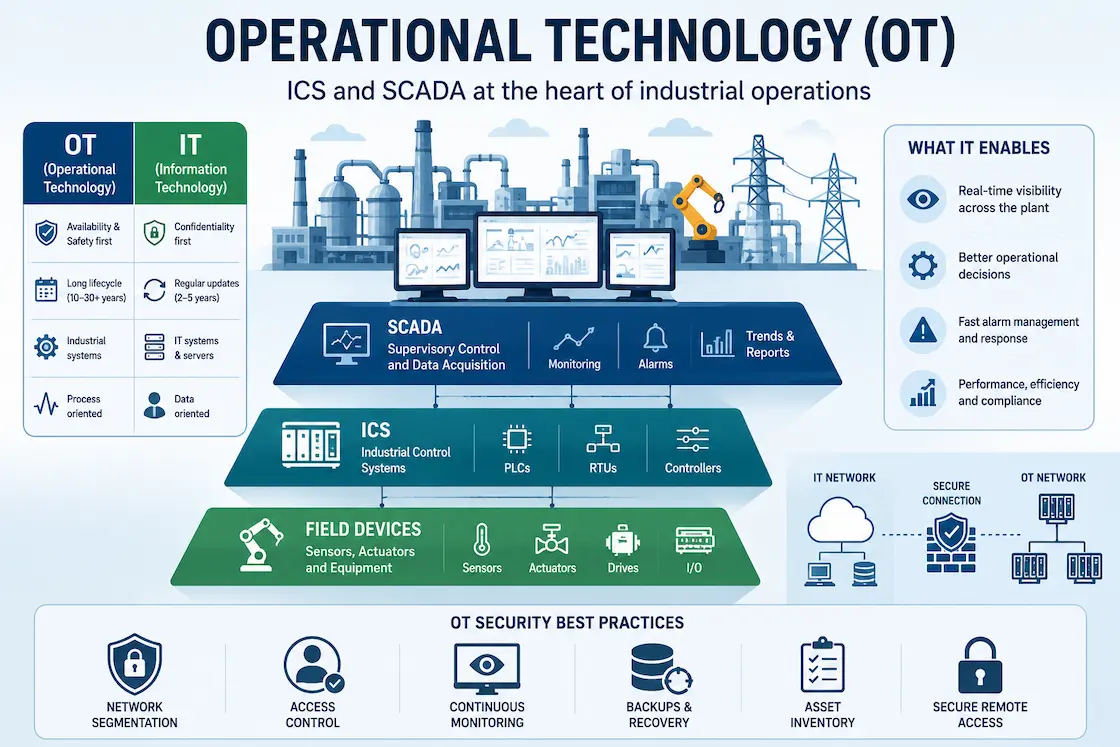
Operational Technology (OT) is the hardware and software that monitors and controls physical processes, equipment and infrastructure — from a bottling line to a power substation. Unlike office computing, OT exists to keep machines running safely and continuously, and it includes PLCs, sensors, actuators, and supervisory platforms such as Winlog Evo. As OT and IT networks increasingly connect for data exchange and remote access, understanding where OT starts and IT ends has become essential for both engineers and security teams.
OT vs IT: key differences
IT (Information Technology) is built around data confidentiality, integrity and availability in that order, with regular patch cycles and standardized hardware refresh every few years. OT flips those priorities: availability and safety come first, because stopping a process unexpectedly can be far more costly or dangerous than a data breach. OT devices also tend to have much longer lifecycles — ten, twenty, even thirty years in service — and many were never designed with network security in mind, since they were originally deployed on isolated, air-gapped networks. This mismatch in priorities and update cadence is the root cause of most friction when IT and OT teams try to converge their infrastructure.
The two worlds also differ in vocabulary and tooling. IT teams think in terms of servers, virtual machines and directory services; OT teams think in terms of tags, scan cycles and setpoints. Bridging this gap usually falls to the SCADA layer, since it is the system that both sides need to interact with: IT for data integration and security, OT for day-to-day supervision and control.
OT, ICS and SCADA systems
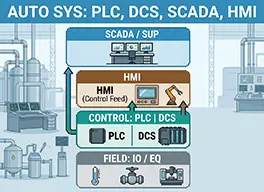
OT is the broad category; ICS (Industrial Control Systems) is the subset of OT specifically responsible for controlling industrial processes, and SCADA is one type of ICS focused on supervisory control and data acquisition across distributed assets. In practice, a SCADA platform like Winlog Evo sits at the top of the OT stack: it aggregates data from PLCs and RTUs, gives operators a unified view across the plant or across multiple sites, and provides the alarms, trends and reports that turn raw OT signals into decisions. Understanding this hierarchy — OT as the umbrella, ICS as industrial control, SCADA as supervisory acquisition — helps teams scope projects and responsibilities correctly.
This hierarchy also clarifies who owns what. Automation engineers typically own the ICS layer — PLC logic, drives, safety systems — while a SCADA administrator owns supervision, historization and reporting on top of it. When OT and IT converge, this distinction helps avoid a common failure mode: an IT team applying generic network policies to ICS devices that were never built to tolerate them, causing outages instead of preventing them.
OT security and cybersecurity
OT security differs from IT security because downtime, not just data loss, is the primary risk, and because many legacy devices cannot simply be patched or rebooted on demand. Reference frameworks such as the NIST guide to industrial control systems security and the resources published by CISA recommend network segmentation between IT and OT, strict access control, continuous monitoring, and asset inventories as baseline practices. A SCADA layer that supports role-based permissions, encrypted remote access and detailed audit logs, as Winlog Evo does, makes it far easier to meet these recommendations without slowing down operations.
In practice, effective OT security is layered rather than a single product: firewalls and demilitarized zones between IT and OT networks, strict management of remote access to SCADA and PLCs, regular backups of control logic and SCADA projects, and monitoring that can flag anomalous traffic on the plant network before it becomes an incident.
Examples of OT in industry
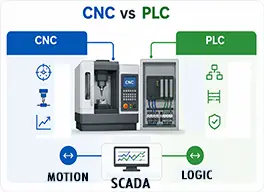
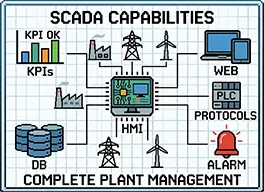
OT spans a wide range of equipment and vendors: PLCs and drives from manufacturers such as Siemens, Rockwell Automation and ABB, distributed control systems in process plants, building automation controllers, and remote terminal units on pipelines and grids. In every one of these environments, a SCADA platform provides the common supervisory layer, connecting through standard protocols to bring OT data into dashboards, historical databases and reports that both engineers and management can use, regardless of which vendor built the underlying hardware.
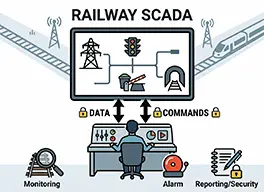
Typical OT deployments include water and wastewater treatment plants supervising pumps and valves, railway signalling and power infrastructure monitoring substations and grid assets, and manufacturing lines coordinating robots, conveyors and quality stations. Across all of them, the underlying pattern is the same: field-level OT devices generate signals, and a SCADA platform turns those signals into visibility, control and accountability.
Want to see how a SCADA layer fits into your OT environment? Try the Winlog Evo web demo, check the supported communication drivers, or contact Sielco Sistemi to discuss your OT architecture.
FAQ
- What is Operational Technology (OT)?
- Operational Technology is the hardware and software that monitors and controls physical processes, equipment and infrastructure, including PLCs, sensors, actuators and supervisory platforms such as SCADA. Unlike office IT, OT exists to keep machines running safely and continuously.
- What is the main difference between OT and IT?
- IT prioritizes data confidentiality, integrity and availability, while OT prioritizes availability and safety first, since stopping a physical process unexpectedly can be far more costly or dangerous than a data breach. OT devices also have much longer lifecycles than typical IT hardware.
- How do OT, ICS and SCADA relate to each other?
- OT is the broad category covering all technology that monitors and controls physical processes. ICS (Industrial Control Systems) is the subset of OT responsible for controlling industrial processes. SCADA is a type of ICS focused on supervisory control and data acquisition across distributed assets.
- What are the key best practices for OT cybersecurity?
- Reference frameworks such as the NIST guide to industrial control systems security and CISA recommend network segmentation between IT and OT, strict access control, continuous monitoring, asset inventories, and SCADA platforms with role-based permissions, encrypted remote access and detailed audit logs.
- What industries rely most heavily on OT?
- Water and wastewater treatment, power grids and substations, railways, oil and gas, and manufacturing lines are among the sectors most reliant on OT, all connecting field devices such as PLCs and RTUs to a SCADA platform for centralized visibility and control.