PLC, DCS, SCADA and HMI differences: how they work and when to choose each
Sielco Sistemi —
Few topics confuse newcomers to industrial automation as much as PLC vs DCS vs SCADA vs HMI. All four show up in the same conversations, sometimes in the same architecture, yet each solves a distinct problem. This guide explains what each layer does, the key differences between them, and how a platform like Winlog Evo fits into a typical automation architecture built from some or all of these building blocks.
What are PLCs, DCS, SCADA and HMI
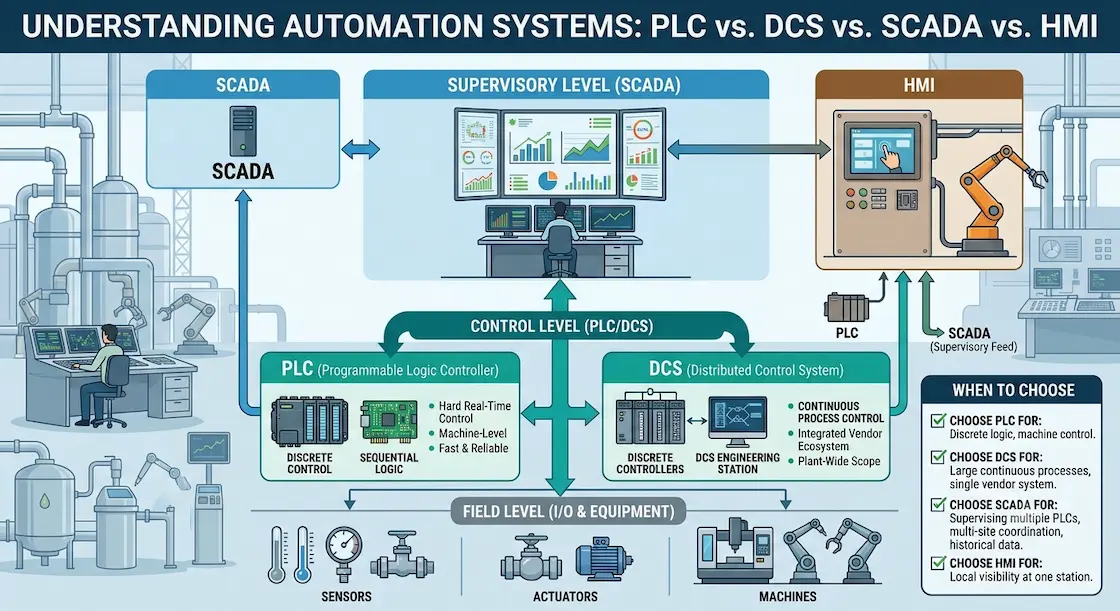
A PLC is a ruggedized controller that executes discrete and sequential logic close to the equipment it drives. A DCS (Distributed Control System) is a control architecture used mainly in continuous process industries, where control functions are distributed across many controllers tightly integrated with engineering and historian tools from a single vendor. SCADA is a supervisory layer that acquires data from PLCs, RTUs or a DCS and gives operators a unified view, often across geographically distributed sites. An HMI is the local operator interface on or near a single machine or panel, showing status and allowing direct interaction with that specific piece of equipment.
Key differences (architecture, data, real-time, scalability)
Architecturally, a PLC is decentralized control logic; a DCS is an integrated, vendor-specific control-and-engineering ecosystem typically deployed as one coherent system across an entire plant; SCADA is a supervisory layer that can sit above PLCs, RTUs or a DCS and is often protocol-agnostic; an HMI is a single-station interface with little or no historian or multi-site capability of its own. In terms of real-time behavior, PLCs and DCS controllers close hard real-time loops, while SCADA operates on a supervisory timescale (seconds, not milliseconds) and focuses on aggregation rather than control-loop execution. Scalability also differs sharply: a DCS scales within one vendor’s ecosystem, while SCADA is generally built to scale across multi-vendor, multi-protocol, multi-site environments, following the layered logic familiar from automation architecture frameworks published by the International Society of Automation.
When to choose PLC, DCS, SCADA or HMI
Choose a PLC when you need fast, reliable discrete or sequential control of a machine or line. Choose a DCS when you are running a large, continuous process plant that benefits from a single integrated vendor ecosystem for control and historian functions. Choose SCADA vs PLC when you need to supervise and coordinate many PLCs, sites or protocols from one place — this is exactly when to choose SCADA over relying on standalone controllers. Choose an HMI when operators simply need local visibility and control at a single station without the overhead of a full supervisory system.
Typical architectures (PLC+SCADA, DCS+HMI, multi-site)
A very common pattern is PLC+SCADA: PLCs from vendors such as Siemens or Rockwell Automation handle machine-level control, while a SCADA platform like Winlog Evo supervises the whole plant or multiple sites. In continuous process industries, DCS+HMI is more typical: a DCS from vendors such as Honeywell, Emerson or Yokogawa runs the process, with HMI stations giving operators local control room visibility, sometimes complemented by a SCADA layer for cross-plant or corporate reporting. Multi-site organizations frequently layer SCADA on top of a mix of PLCs and DCS installations from different vendors, using it as the common integration point.
Integrations with CNC, BMS and IoT/IIoT
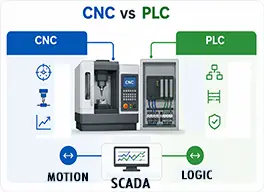
Beyond the core four, real plants also integrate CNC machines, BMS for facilities, and IoT/IIoT devices and gateways, an area increasingly standardized by the Industrial Internet Consortium. A SCADA platform is usually the natural integration point for all of these, since it already speaks the communication protocols needed to pull data from CNCs, BMS controllers and IoT gateways through a shared library of communication drivers, avoiding a patchwork of point-to-point integrations.
Comparison table and selection checklist
| System | Primary role | Real-time control | Typical scope |
|---|---|---|---|
| PLC | Discrete/sequential logic control | Yes, hard real-time | Single machine or line |
| DCS | Continuous process control | Yes, hard real-time | Whole plant, single vendor |
| SCADA | Supervisory control and data acquisition | No, supervisory timescale | Plant or multi-site, multi-vendor |
| HMI | Local operator interface | No | Single station or panel |
As a checklist: map how many sites and vendors you need to cover, decide whether continuous process or discrete/sequential control dominates, confirm whether operators need local-only visibility or plant-wide supervision, and check protocol and reporting requirements. Platforms such as Winlog Evo are designed to sit on top of PLC, DCS and HMI layers alike, covering the SCADA vs DCS and SCADA vs HMI gap with a single supervisory tool.
Want help mapping your own automation architecture? Try the Winlog Evo web demo, review the supported communication drivers, or contact Sielco Sistemi for a tailored assessment.
FAQ
- What is the difference between SCADA and a PLC?
- A PLC executes real-time discrete and sequential control logic close to the equipment. SCADA is a supervisory layer that acquires data from one or many PLCs, giving operators a unified view, alarms, trends and reports across a plant or multiple sites.
- What is the difference between SCADA and a DCS?
- A DCS is an integrated, vendor-specific control and engineering ecosystem typically deployed across an entire continuous-process plant. SCADA is a supervisory, often protocol-agnostic layer that can sit above a DCS, PLCs or RTUs, and is generally better suited to multi-vendor, multi-site environments.
- What is the difference between SCADA and an HMI?
- An HMI is a local operator interface for a single machine or panel, with little or no historian or multi-site capability. SCADA is a broader supervisory system that aggregates data across many machines or sites, with historical logging, alarm management and reporting.
- Which typical architecture combines PLC, DCS, SCADA and HMI?
- A common pattern is PLC+SCADA for discrete manufacturing, where PLCs handle machine-level control and SCADA supervises the plant or multiple sites. In continuous process industries, DCS+HMI is more typical, often with a SCADA layer added on top for cross-plant or corporate reporting.
- How does SCADA integrate with CNC, BMS and IoT/IIoT devices?
- A SCADA platform typically acts as the common integration point, connecting to CNC machines, BMS controllers and IoT gateways through a shared library of communication drivers, avoiding a patchwork of point-to-point integrations.