Home Page » About Us » Case History » Food Quality Control System
SCADA Quality Control for Ice Cream and Dairy By-Product Manufacturing
Sielco Sistemi —
In order to guarantee the hygiene and the safety of food products, new rules for consumer safeguard have been introduced across the food industry, both established by international control organizations and autonomously decided by manufacturers seeking to differentiate themselves through superior quality assurance. These regulations increasingly require objective, documented evidence that every stage of a manufacturing process has been carried out under controlled and traceable conditions, in line with internationally recognized frameworks such as HACCP. The SCADA system presented here has been developed by Sielco Sistemi for a company that produces ice cream and other by-products of milk
Continuous Monitoring of the Pasteurization Process
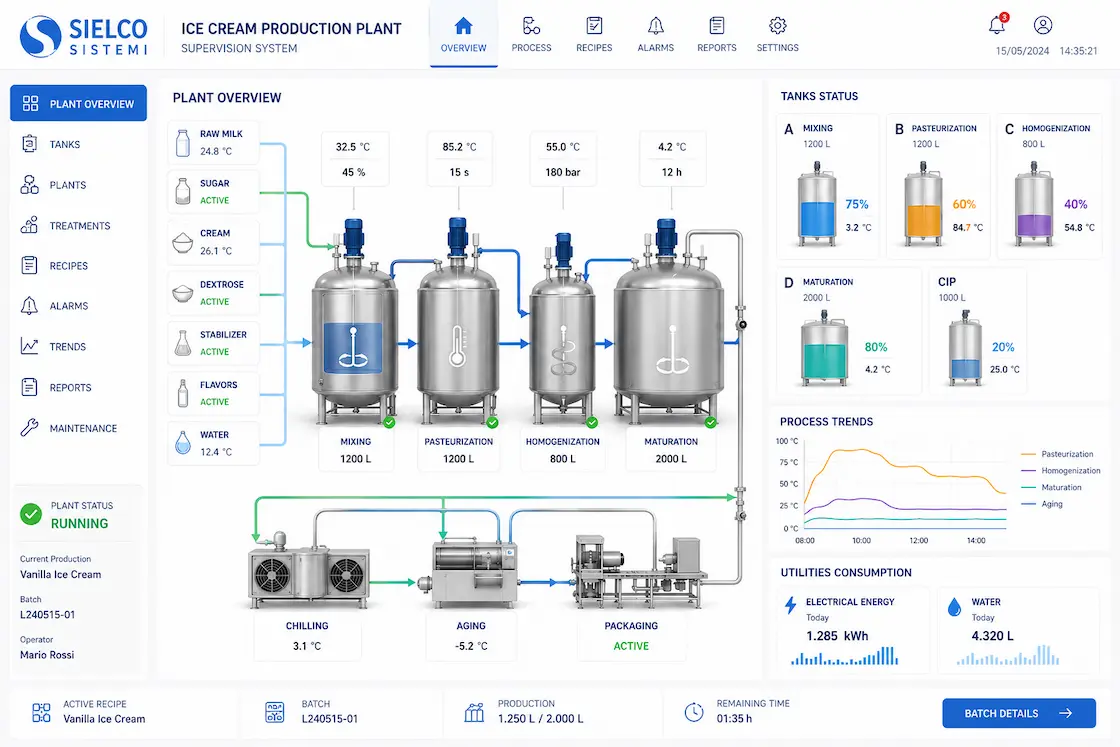
Pasteurization is the single most important step for guaranteeing the microbiological safety of any dairy product, and even small deviations in temperature or holding time can compromise an entire production batch. The SCADA system continuously acquires data from temperature sensors, flow meters, and PLCs installed along the pasteurization line, comparing the actual process values against the target curve in real time. Whenever the time-temperature profile required for safe pasteurization is not respected, the system immediately flags the deviation, allowing operators to intervene before the affected milk or cream mixture moves further down the production line. This continuous, automated supervision removes the uncertainty of manual spot-checks and creates a complete, time-stamped record proving that every batch has actually undergone the pasteurization conditions required by food safety regulations, rather than simply assuming that the equipment performed as expected.
Systematic Control of Ripening Tanks
After pasteurization, dairy mixtures intended for ice cream production are typically transferred to ripening tanks, where they rest under controlled temperature and agitation conditions before further processing. The working status of each tank — including temperature, stirring speed, residence time, and fill level — is constantly monitored by the SCADA system, which logs every parameter and generates an alarm if any value drifts outside the approved operating range. This systematic, tank-by-tank control ensures that every mixture reaches the correct degree of maturation before it is drawn off for freezing or further blending, helping the manufacturer maintain a consistent texture, flavor, and shelf life across every production run, regardless of which tank or shift is involved.
Verifying the Effectiveness of Tank Cleaning and Sterilization
Because the same tanks and pipework are reused for successive production batches, the effectiveness of cleaning and sterilization cycles is just as critical to food safety as the pasteurization step itself. Residual product, biofilm, or inadequately sanitized surfaces can become a source of microbiological contamination that no amount of downstream control can fully correct. The SCADA platform monitors the key variables of each CIP (Clean-in-Place) cycle — detergent and sanitizer concentration, water temperature, flow rate, and cycle duration — and automatically certifies whether the cleaning sequence met the validated parameters before the tank is approved for the next production run. This automated verification replaces subjective visual inspection with an objective, auditable record, giving quality managers documented proof that every piece of equipment was properly sanitized prior to reuse.
Coordinating a Distributed Manufacturing Process via TCP/IP Client Stations
Modern dairy plants are often organized into multiple departments — receiving, pasteurization, ripening, freezing, packaging — that may be physically distributed across a wide production area. One or more Client stations, linked together via a TCP/IP network, make all the information generated by the SCADA system available to every department, allowing supervisors and operators in different areas of the plant to see the same real-time data and coordinate their actions accordingly. This networked architecture means that a delay or anomaly detected at the pasteurization stage can be immediately visible to the ripening and freezing departments downstream, preventing miscommunication and ensuring that the whole manufacturing process moves forward in a coordinated, synchronized way rather than as a series of disconnected operations.
Graphical Reports Certifying Product Quality and Process Compliance
All the variables that have been acquired from the field — temperatures, pressures, tank statuses, CIP cycle parameters, and more — are processed by the system to generate a series of reports with graphical trends that certify both the quality of the final product and the integrity of the whole manufacturing process. These reports give quality assurance teams an immediate visual representation of how each critical variable behaved throughout production, making it easy to confirm at a glance that a batch was produced within specification, or to quickly pinpoint the exact moment a deviation occurred if an issue is later identified. Because the reports are generated automatically and stored digitally, they can be retrieved instantly during internal audits, customer quality reviews, or inspections by food safety authorities, replacing slower and less reliable paper-based documentation systems.
Tracking Plant Productivity and Raw Material Consumption
Beyond pure quality certification, the system also provides reports that give detailed information about general plant productivity and raw materials consumption. By correlating the volume of milk, cream, sugar, and other ingredients drawn into the process with the corresponding output of finished ice cream and dairy by-products, plant managers gain a clear, data-driven view of production efficiency, ingredient yield, and potential sources of waste. This information supports better purchasing decisions, more accurate cost accounting, and continuous improvement initiatives, turning the SCADA system from a purely compliance-oriented tool into a broader instrument for operational and financial decision-making across the entire dairy production facility.
A Complete Quality and Efficiency Solution for Dairy Manufacturers
Taken together, the capabilities of this SCADA implementation — pasteurization control, ripening tank supervision, CIP cycle certification, multi-department coordination via TCP/IP, automated graphical reporting, and productivity tracking — provide ice cream and dairy by-product manufacturers with a single, integrated solution to satisfy both regulatory food safety requirements and internal operational goals. By replacing manual checks and paper records with continuous, automated supervision, the system minimizes the risk of human error at every stage, strengthens traceability across the entire production chain, and gives manufacturers the documented evidence they need to demonstrate, to regulators and customers alike, that hygiene, safety, and quality have been consistently maintained from raw milk intake to finished product.
FAQ
- How does SCADA improve ice cream production quality?
- Winlog Evo SCADA continuously supervises pasteurization, maturation tanks and CIP cleaning cycles. Real-time monitoring and historical data guarantee product consistency, batch traceability and compliance with food safety standards.
- Why is pasteurization control essential in ice cream production?
- Precise temperature and time control eliminate microbiological risks and ensure food safety. SCADA systems continuously verify process parameters and generate certified reports.
- How are CIP cleaning processes monitored?
- The SCADA platform monitors detergent concentration, water temperature, flow rate and cycle duration. Each cleaning process is recorded and validated before production restarts.
- Can several production departments share information in real time?
- Yes. Through TCP/IP communication and client workstations, all departments can access the same process information and coordinate production activities efficiently.
- Can Winlog Evo SCADA support Industry 4.0 integration?
- Yes. The platform can integrate with PLCs, MES, ERP systems and SQL databases, enabling digitalization, production analysis and predictive maintenance.