Home Page » About Us » Case History » Polypropylene Yarn Production Control
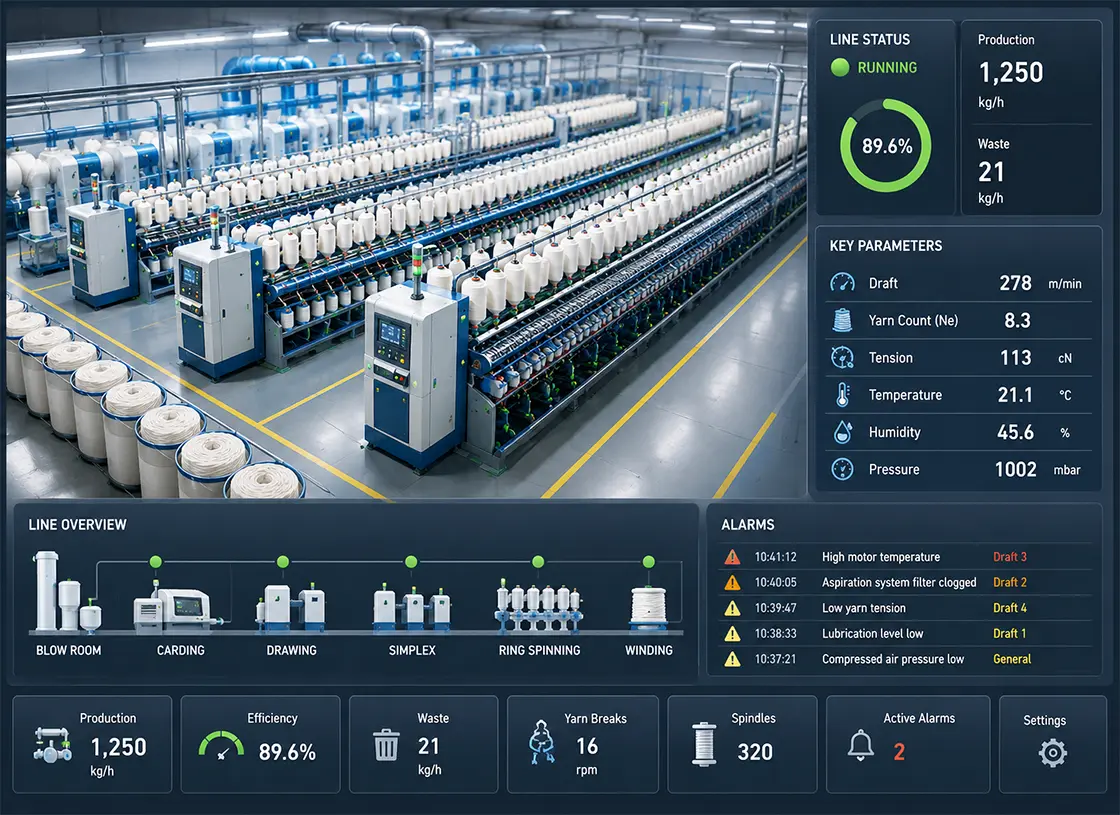
SCADA supervisory system for polypropylene yarn manufacturing: colour consistency, recipe management and quality reporting
Sielco Sistemi —
Due to the sophisticated manufacturing process required by polypropylene yarns, technology has a decisive weight; the supervisory control of the whole manufacturing process makes it possible to produce any colour and to reproduce it consistently also after many months. The supervisory system guarantees that all product characteristics (torsions, title, tenacity, stabilization, ...) fit perfectly with the technical specifications requested by the customer, allowing product standardization with a consequent reduction of production and delivery times.
Behind this reliability lies a layered automation architecture built around SCADA (Supervisory Control and Data Acquisition) technology. A modern SCADA platform does far more than display values on a screen: it continuously acquires process data from the field, compares it against recipe targets, raises an alarm the moment a parameter drifts outside tolerance, and archives every measurement for traceability and quality audits. For polypropylene yarn lines, where colour matching and mechanical properties must remain stable across very long production runs, this continuous data acquisition is what turns a collection of independent machines into a single, coordinated production system.
All phases of the manufacturing process — dosing of polymer and colour, heating, extrusion, stabilization, and final winding with automatic spool change-over — are constantly controlled by the supervisory system. Dosing accuracy is what determines colour repeatability batch after batch, since even small variations in pigment ratio are visible to the human eye. Heating profiles must be held within narrow bands to keep the polymer melt homogeneous before it reaches the die. The extrusion stage shapes the molten polymer into continuous filaments under closely monitored pressure and temperature, and any deviation here propagates directly into yarn tenacity and titre. Stabilization then fixes the molecular orientation and dimensional properties achieved during extrusion, so that the yarn keeps its mechanical performance in storage and during downstream processing such as weaving or tufting. Finally, the winding stage — with its automatic spool change-over — keeps the line running without interruption even as full spools are replaced, avoiding the production losses a manual changeover would otherwise cause on a continuous process.
Thanks to various serial channels with appropriate protocols, the supervisory system communicates with all control devices on the line: PLCs (programmable logic controllers, frequently from established automation vendors such as Siemens SIMATIC S7 ), temperature and pressure controllers, motor drives, and process indicators. Communication commonly relies on widely adopted industrial protocols such as Modbus alongside proprietary serial links, which allow the supervisory layer to poll dozens of field devices in real time without overloading the plant network. This heterogeneous-device integration is precisely what makes a single supervisory platform able to oversee a complete yarn line — dosing units, extruders, ovens, and winders — built up over the years from equipment of different ages and different suppliers, without forcing the producer into a costly, all-at-once hardware replacement.
The man/machine interface (HMI) is simple, prompt and effective. It displays plant templates with different levels of detail — from a synoptic overview of the whole line down to a single extruder zone — so operators can move seamlessly from a bird’s-eye view to a detailed diagnostic screen. It gives an immediate signalling of any new alarm or abnormal condition, with prioritized alarm banners that help operators react to the most critical deviations first rather than being overwhelmed by minor notifications. It also allows management of working recipes organised by customer or article, so that a changeover between products becomes a matter of loading a validated recipe rather than re-entering dozens of setpoints by hand — a feature that directly shortens changeover time and reduces the risk of human error on lines that may run dozens of different colours and articles in a single week.
Beyond real-time control, the system provides quality reports with graphical trends of all significant variables of the process. These historical trends let process engineers correlate a quality deviation discovered downstream with the exact process conditions recorded hours or days earlier, turning troubleshooting from guesswork into evidence-based analysis. This kind of structured data collection is also what makes polypropylene yarn lines compatible with broader Industry 4.0 initiatives: production data captured at machine level can feed plant-wide dashboards, MES systems, and long-term analytics with no additional manual data entry, closing the loop between the shop floor and management reporting.
Taken together, these capabilities deliver tangible commercial benefits: consistent colour and mechanical properties across batches, faster and more reliable changeovers between articles, full traceability for quality audits, and a measurable reduction in both production and delivery times. For yarn producers competing in technical textiles, geotextiles, and industrial fabrics markets, this combination of process control, data visibility, and recipe management is what allows a single production line to serve many customers with confidence, without sacrificing the standardization that large-scale, repeat-order business demands.
FAQ
- How does a supervisory control system improve polypropylene yarn production?
- The supervisory system monitors every production stage in real time, guaranteeing colour consistency, process stability and compliance with customer specifications.
- Which process variables are monitored during yarn production?
- Temperature, pressure, polymer dosing, extrusion parameters, yarn twist, tenacity and stabilization are continuously monitored to ensure constant quality.
- Can production recipes be managed automatically?
- Yes. Recipe management allows operators to store and recall process parameters according to products and customer requirements.
- How does HMI improve operator efficiency?
- HMI screens provide alarms, trends, production reports and detailed process visualization, simplifying plant management.
- Can the supervisory system communicate with PLCs and industrial devices?
- Yes. Through serial communication protocols, the supervisory platform exchanges data with PLCs, drives, sensors and temperature controllers.