Home Page » About Us » Case History » Medical Temperature Monitoring
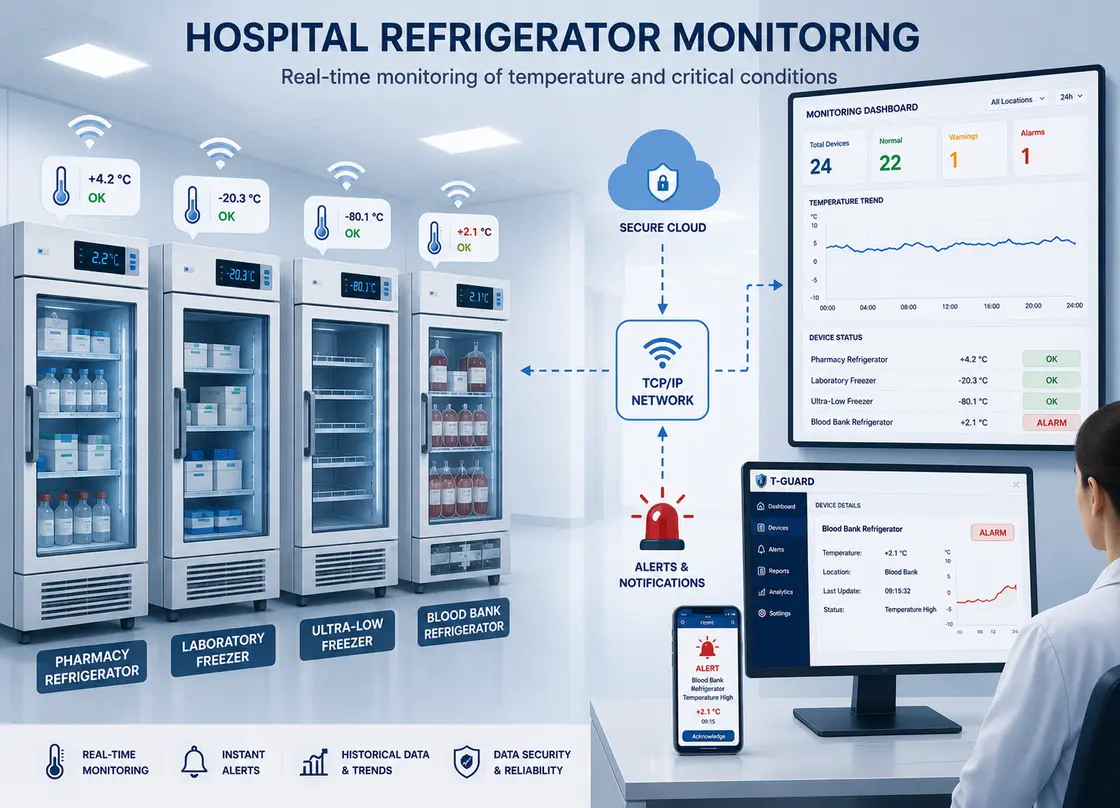
Continuous monitoring of medical devices in hospitals and research facilities
Sielco Sistemi —
Why Continuous Temperature Monitoring is Critical in Hospitals and Research Facilities
In hospitals, blood banks, pharmacies and biomedical research laboratories, maintaining a stable and controlled temperature inside refrigerators, freezers and cryogenic storage units is not merely a matter of operational efficiency — it is a patient safety and regulatory obligation. Biological samples, blood components, human tissues, vaccines and pharmaceutical products all have strict storage temperature requirements that, if breached even briefly, can lead to the irreversible degradation of irreplaceable materials. The consequences range from compromised diagnostic results to the total loss of tissue bank specimens that took months or years to collect and process. Regulatory frameworks such as the European Union Medical Device Regulation (EU MDR 2017/745) and the quality standards of the ISO 9000 family place specific obligations on healthcare facilities to document and verify the conservation conditions of biological materials continuously and to demonstrate conformity through auditable records.
T-guard: a SCADA-Based Medical Temperature Monitoring System
T-guard is a dedicated medical temperature monitoring system developed by Sielco Sistemi in partnership with Sincronis, built on the Winlog Evo SCADA software platform. Installed in numerous hospitals and research facilities across Europe, T-guard provides continuous, automated supervision of all medical devices equipped with temperature control, including refrigerators, freezers, ultra-low temperature freezers and cryogenic storage units. By replacing manual spot-checks and paper logs with a fully automated Supervisory Control and Data Acquisition (SCADA) layer, T-guard ensures that the temperature conditions required for the long-term conservation of special tissues, biological materials and pharmaceutical products are maintained and documented without any gap, 24 hours a day, 365 days a year.
Continuous Acquisition and Intelligent Alarm Filtering
At the heart of the T-guard system is a continuous data acquisition engine that reads temperature measurements from sensors installed in every monitored device at configurable sampling intervals. Rather than generating a raw alarm on every momentary fluctuation — which would overwhelm maintenance staff with false positives — the system applies intelligent alarm filtering based on user-defined settings. Transient deviations caused by door openings, defrost cycles or brief load changes are automatically distinguished from persistent anomalies that indicate a genuine equipment malfunction or failure. Only when a temperature excursion exceeds the configured threshold for a sustained period does the system escalate to a formal alarm condition, significantly reducing alarm fatigue while ensuring no real fault goes undetected.
Multi-Level Alarm Management: Local Signals and SMS Notification
Once a persistent anomaly is confirmed, T-guard activates an alarm response proportional to the severity of the event. For lower-priority conditions, a local signal — such as a siren or an alarm lamp — is activated in the immediate vicinity of the affected device, alerting staff present in the area without disturbing the rest of the facility. For higher-priority or critical alarms, the system automatically broadcasts an SMS notification to the cellular phone of the designated maintenance technician, ensuring that the responsible person is alerted immediately regardless of their location within the hospital or facility. This multi-level escalation model is particularly valuable in large hospitals where the monitored devices may be distributed across multiple wards, floors and buildings, and where a single technician may be responsible for dozens of units simultaneously.
TCP/IP Network Architecture and Client Analysis Stations
T-guard is built on a TCP/IP network architecture with a robust client/server structure, making it suitable for deployment across the complex, distributed infrastructure of a modern hospital or multi-building research campus. All data relating to device functionality and biological material conservation — temperature trends, alarm histories, equipment identifiers and user actions — is transmitted in real time to one or more client analysis stations, giving laboratory managers, quality officers and biomedical engineers instant access to the full picture of the monitoring system from any networked workstation. The server continues to acquire and log data even when no client is actively connected, guaranteeing data integrity and a complete, uninterrupted audit trail at all times. This architecture is well aligned with the principles of modern cold chain management, where end-to-end traceability of storage conditions is as important as the physical maintenance of temperature itself.
Automated Reporting for ISO 9000 Quality Certification
One of the most practically significant features of T-guard is its automated reporting capability. At configurable time intervals or on direct user request, the system generates periodic reports that summarize the temperature conditions recorded by each monitored device over the selected period, including any alarm events and the corrective actions logged by operators. These reports are the primary documentary evidence required to obtain and maintain Quality Certification in accordance with European ISO 9000 standards, which demand that healthcare organizations demonstrate through auditable records that their storage conditions consistently meet the specifications required for each category of biological material or pharmaceutical product. By producing these reports automatically, T-guard eliminates the time-consuming manual compilation of temperature logs that characterizes paper-based systems, reduces the risk of documentation gaps during audits and gives quality managers the confidence that certification evidence is always complete and up to date.
Tissue Banks and Biomedical Research: Long-Term Conservation Under Control
The system has proven particularly valuable in tissue banks and biomedical research environments, where biological specimens must be stored under precisely controlled conditions for months or years without interruption. In these settings, a single undetected temperature excursion can destroy samples of immense scientific or clinical value — specimens that may be irreplaceable because they were collected from specific patient populations, experimental cohorts or rare biological events. T-guard’s combination of continuous monitoring, intelligent alarm filtering and automated reporting makes it the ideal platform for these high-stakes conservation environments, providing the documented evidence of conformity that research institutions need to meet the requirements of ethics committees, grant bodies and regulatory inspectors.
A Scalable, Future-Proof Platform for Healthcare Facilities
Because T-guard is built on the Winlog Evo SCADA platform, it inherits all the scalability and integration capabilities of a fully featured industrial supervisory system. New devices and monitoring points can be added to an existing installation without redesigning the application, making the system a long-term investment that grows alongside the facility. The open architecture also allows T-guard to be integrated with hospital information systems, building management platforms and future IoT infrastructure, ensuring that the investment made today in reliable, certified medical temperature monitoring continues to deliver value as healthcare facilities evolve and digital transformation reshapes clinical operations.
FAQ
- What is T-guard and which medical devices can it monitor?
- T-guard is a medical temperature monitoring system developed by Sielco Sistemi in partnership with Sincronis, built on the Winlog Evo SCADA software platform. It provides continuous, automated supervision of all medical devices equipped with temperature control, including refrigerators, freezers, ultra-low temperature freezers and cryogenic storage units used in hospitals and research facilities.
- How does T-guard distinguish real equipment faults from normal, temporary temperature fluctuations?
- T-guard applies intelligent alarm filtering based on user-defined settings, automatically distinguishing transient deviations caused by door openings, defrost cycles or brief load changes from persistent anomalies that indicate a genuine malfunction. Only when a temperature excursion exceeds the configured threshold for a sustained period does the system escalate to a formal alarm, reducing false positives without missing real faults.
- How are critical alarms communicated to maintenance staff in T-guard?
- T-guard activates an alarm response proportional to the severity of the event. Lower-priority conditions trigger a local signal such as a siren or lamp near the affected device, while higher-priority or critical alarms automatically broadcast an SMS notification to the cellular phone of the designated maintenance technician, ensuring immediate awareness regardless of the technician’s location within the facility.
- What reports does T-guard generate and how do they support ISO 9000 quality certification?
- At configurable time intervals or on user request, T-guard generates periodic reports summarizing the temperature conditions recorded by each monitored device, including alarm events and corrective actions. These reports are the primary documentary evidence required to obtain and maintain Quality Certification in accordance with European ISO 9000 standards, eliminating manual log compilation and reducing the risk of documentation gaps during audits.
- Why is T-guard particularly well suited to tissue banks and biomedical research facilities?
- In tissue banks and biomedical research environments, biological specimens must be stored under precisely controlled conditions for months or years without interruption, and a single undetected temperature excursion can destroy irreplaceable samples. T-guard’s combination of continuous monitoring, intelligent alarm filtering and automated reporting provides the documented evidence of conformity that research institutions need to meet the requirements of ethics committees, grant bodies and regulatory inspectors.