SCADA vs IoT/IIoT: strengths, differences and integration for Industry 4.0
Sielco Sistemi —
As factories connect more sensors and devices than ever, SCADA vs IoT has become a real architectural question rather than a marketing debate. Both collect and expose field data, but SCADA and IoT/IIoT come from different traditions and solve different problems well. This guide compares their strengths and shows how a platform such as Winlog Evo bridges the two in a modern Industry 4.0 architecture.
What is IoT/IIoT (edge, cloud, devices)
Industrial IoT (IIoT) refers to networks of sensors and devices, often battery-powered or low-cost, that send data to edge gateways or directly to cloud platforms for storage and analytics. IIoT devices are typically designed for easy, low-cost deployment at scale, favoring wireless connectivity and lightweight protocols over the deterministic, wired architectures common in classic automation. Standardization bodies such as the Industrial Internet Consortium have worked to bring more structure and interoperability to this fast-growing space.
SCADA vs IoT: differences (data model, timing, governance)
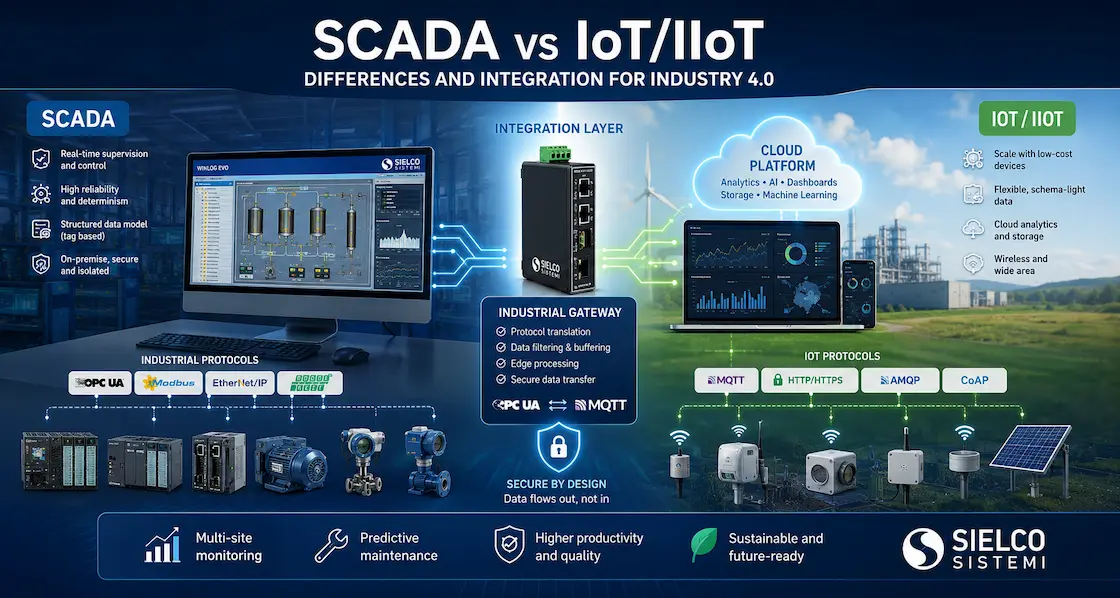
SCADA is built around a structured tag database tightly coupled to specific field devices and protocols, with strong guarantees about timing, data quality and access control — governance sits with the plant’s automation team. IoT platforms are typically built around flexible, schema-light data streams designed for massive scale and cloud analytics, often governed by IT or a cloud vendor rather than plant engineering. Timing requirements differ too: SCADA is expected to reflect near-real-time process state reliably, while many IoT pipelines tolerate delay and occasional data loss in exchange for scale and low cost. Neither model is wrong; they are optimized for different problems.
Security governance also diverges: SCADA networks are usually deliberately isolated from the internet, with remote access tightly controlled, while IoT devices are often designed to reach a cloud endpoint directly. This is precisely why the two are rarely merged into a single flat network, even when their data ends up in the same dashboard.
When to use SCADA, when to use IoT, and when to use both
Use SCADA when you need reliable, low-latency supervision and control of production-critical equipment, with strict data integrity and a clear chain of responsibility. Use IoT/IIoT when you need to add low-cost sensors at scale — vibration monitoring across hundreds of non-critical motors, for example — where occasional data gaps are acceptable and cloud-based analytics add value. Most mature Industry 4.0 architectures use both: SCADA for the core process, IoT for supplementary sensing and analytics layered on top, feeding insights back into maintenance and quality processes without touching the control loop itself.
A simple test helps decide: if losing a data point for a few minutes would be a safety or quality problem, it belongs on SCADA; if losing it only delays a dashboard update or a maintenance alert, IoT is an acceptable, cheaper choice.
SCADA and IoT integration (gateway, APIs, history, MQTT)
SCADA IoT integration typically happens through an industrial gateway that translates between SCADA protocols (Modbus, OPC UA) and IoT protocols such as MQTT, or through industrial APIs that expose SCADA history and live values to cloud applications. Winlog Evo supports this pattern through its communication drivers and SQL-based historian, which can feed cloud dashboards and analytics tools without exposing the control network directly to the internet, keeping the security boundary where it belongs.
This gateway pattern also means the integration can be one-directional by design: data flows out from SCADA to the cloud for analytics, without opening any path for external systems to write back into the control network, which is the safest default for most industrial deployments.
Use cases in Industry 4.0/5.0 (multi-site, analytics, maintenance)
In practice, this SCADA-plus-IoT pattern shows up in multi-site energy benchmarking across factories, predictive maintenance programs that combine SCADA process data with IoT vibration and temperature sensors, and corporate dashboards that aggregate KPIs from dozens of plants into a single cloud view for Industry 4.0 and emerging Industry 5.0 initiatives focused on resilience and human-centric operations. In all of these cases, SCADA remains the trusted source of truth for control, while IoT extends visibility and analytics beyond what a single site’s SCADA system was ever meant to cover alone.
Want to see SCADA and IoT integration in practice? Try the Winlog Evo web demo, review the supported communication drivers, or contact Sielco Sistemi for guidance.
FAQ
- What is the main difference between SCADA and IoT/IIoT?
- SCADA is built around a structured tag database with strong guarantees on timing and data quality for production-critical control, while IoT/IIoT platforms favor flexible, low-cost, massively scalable data streams that tolerate occasional delay or loss.
- How does a SCADA system typically connect to IoT platforms?
- Through an industrial gateway that translates between SCADA protocols (Modbus, OPC UA) and IoT protocols such as MQTT, or through industrial APIs that expose SCADA history and live values to cloud applications.
- When should I use IoT instead of SCADA for a new sensor deployment?
- Use IoT when adding low-cost sensors at scale on non-critical equipment, where occasional data gaps are acceptable and cloud-based analytics add value, such as vibration monitoring across hundreds of non-critical motors.
- Is SCADA-IoT integration a security risk?
- Not if designed correctly: a gateway pattern lets data flow out from SCADA to the cloud for analytics without opening any path for external systems to write back into the control network, which is the safest default approach.
- How do SCADA and IoT support Industry 4.0 together?
- SCADA remains the trusted source of truth for control, while IoT extends visibility and analytics for use cases like multi-site energy benchmarking, predictive maintenance, and corporate dashboards aggregating KPIs across many plants.