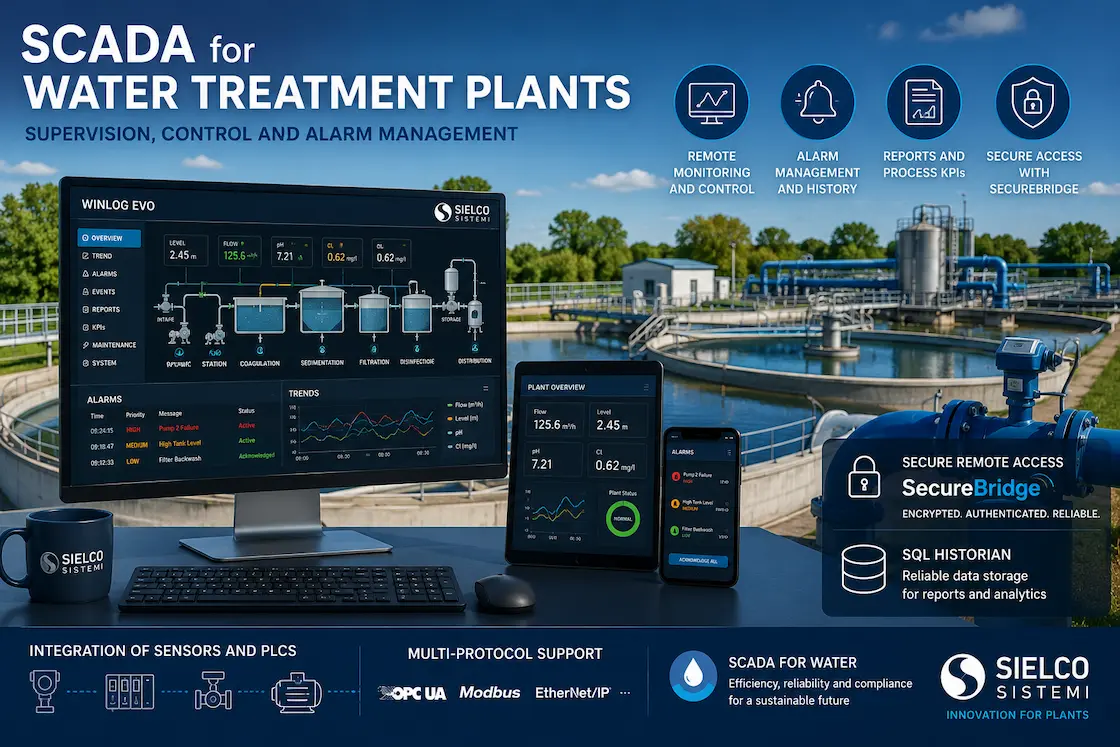
SCADA for water treatment plants: supervision, control and alarm management
Sielco Sistemi —
Water and wastewater treatment plants combine pumps, valves, filters, dosing systems and water purification stages that must run continuously and within tight quality limits, often across sites spread over a wide service area. SCADA for water treatment plants brings this scattered equipment under one supervisory view, turning raw sensor readings into the alarms, history and reports that operators and regulators both need. Winlog Evo is a reference example of a SCADA/HMI platform built to cover this role from a single control room or remotely.
Remote monitoring and control for plants
Water treatment plant SCADA lets a small team supervise intake stations, treatment basins, pump stations and distribution points without stationing staff at every site. Operators can view live tank levels, flow rates, pressure and chemical dosing from a central dashboard, and issue commands — starting a pump, opening a valve, adjusting a setpoint — without traveling to the physical location. Because many treatment assets sit in remote or unmanned locations, secure remote access matters as much as the monitoring itself: Winlog Evo supports this through SecureBridge, which lets engineers reach a distant station for diagnostics or configuration changes over an encrypted, authenticated connection rather than exposing controllers directly to the internet.
This centralized view also changes how maintenance teams work: instead of driving to a site to check whether a pump is running or a level is normal, staff can triage remotely and only dispatch a crew when the data confirms a physical intervention is actually needed, which cuts unnecessary trips across a service area that may span an entire municipality or region.
Alarm management and event history
A treatment process that drifts out of tolerance, even briefly, can affect water quality or trigger a compliance issue, so SCADA for a water treatment plant needs alarm handling that operators can trust. Priority levels separate a critical dosing fault from a routine filter-backwash notification, acknowledgement workflows track who responded and when, and escalation rules make sure nothing serious goes unnoticed during a shift change. Every alarm and operator action is also timestamped and stored in a persistent event history, which supports both day-to-day troubleshooting and the kind of audit trail that water utilities are commonly required to produce for regulators.
Because water and wastewater plants often operate around the clock with rotating shifts, a well-tuned alarm system also has to work as an effective handover tool: an incoming operator can review what happened during the previous shift in minutes, rather than relying solely on verbal handover notes.
Reports and process KPIs
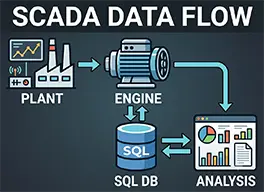
Beyond real-time supervision, treatment plants need to demonstrate performance over time: production volumes, chemical consumption, energy use, downtime and compliance parameters typically feed into scheduled reports for management and regulatory bodies alike. Because Winlog Evo can write and read data directly from a SQL historian, these process KPIs can be queried, charted and exported without relying on manual data entry or proprietary log formats, and can be cross-referenced with laboratory results to build a complete picture of treatment performance across days, months or years.
Integration of sensors and PLCs
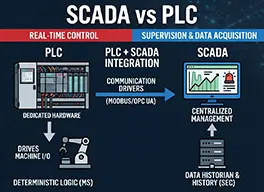
Treatment plants typically combine instrumentation and PLCs from several manufacturers, installed and expanded over many years, which means a SCADA platform needs broad protocol support rather than a single fixed integration path. Winlog Evo’s library of communication drivers connects to PLCs and instruments over Modbus, OPC UA and other common industrial protocols, and the device support list makes it straightforward to check compatibility with existing hardware before adding a new station to an established SCADA project.
SCADA for water
Across the sector, from municipal drinking-water systems to industrial wastewater treatment, the operational principles promoted by bodies such as the International Water Association line up closely with what a good SCADA deployment provides: continuous monitoring, rapid fault detection, and data that supports both daily operations and long-term planning. SCADA for water is not a one-time installation but an operational backbone that grows as new treatment stages, sensors or sites are added over the life of the infrastructure.
Curious how SCADA looks in a real water treatment plant? Try the Winlog Evo web demo, browse the supported communication drivers, or contact Sielco Sistemi to request a demo.
FAQ
- What does SCADA monitor in a water treatment plant?
- SCADA monitors tank levels, flow rates, pressure and chemical dosing across intake stations, treatment basins, pump stations and distribution points, bringing all of this scattered equipment into one central dashboard.
- How does SCADA support compliance reporting for water utilities?
- By timestamping every alarm and operator action and storing them in a persistent event history, and by writing production, chemical and energy data directly to a SQL historian that can be queried and exported for scheduled compliance reports.
- Why is secure remote access important for water treatment SCADA?
- Because many treatment assets sit in remote or unmanned locations, engineers need to reach them for diagnostics or configuration changes without exposing field controllers directly to the internet, which is why encrypted, authenticated tools such as SecureBridge matter.
- Can a SCADA platform integrate PLCs and sensors from different manufacturers?
- Yes, provided the platform has a broad communication driver library covering protocols such as Modbus and OPC UA, which lets treatment plants combine instrumentation and PLCs installed and expanded over many years without a single fixed integration path.
- How does SCADA reduce unnecessary site visits at water treatment plants?
- By letting staff triage a plant remotely through live data before deciding whether a physical visit is needed, so a crew is only dispatched when the data confirms an intervention is genuinely required.