SCADA vs BMS: differences and selection criteria for industry and buildings
Sielco Sistemi —
Both a SCADA system and a BMS (Building Management System) supervise equipment and collect data, yet they were built for very different worlds: industrial processes versus commercial and institutional buildings. Understanding SCADA vs BMS differences matters because choosing the wrong category of platform, or trying to force one into the other’s role, usually costs more than it saves. This guide compares both and shows where a platform such as Winlog Evo fits.
What is a BMS and what does it manage
A BMS (also called a Building Automation System) manages HVAC, lighting, access control, fire and life-safety systems, and energy consumption across offices, hospitals, schools and other commercial or institutional buildings. Its priorities are occupant comfort, energy efficiency and code compliance, and it typically speaks building-specific protocols such as BACnet and KNX. A BMS is usually installed and commissioned by mechanical and electrical contractors as part of a broader building project, rather than by an automation integrator.
Most BMS platforms are also organized around zones and schedules rather than continuous processes: a floor, a wing or a room is treated as a single controllable zone with occupancy-driven setpoints, which is a very different mental model from the tag-by-tag, device-by-device view typical of industrial SCADA.
SCADA vs BMS: differences (goals, scale, protocols)
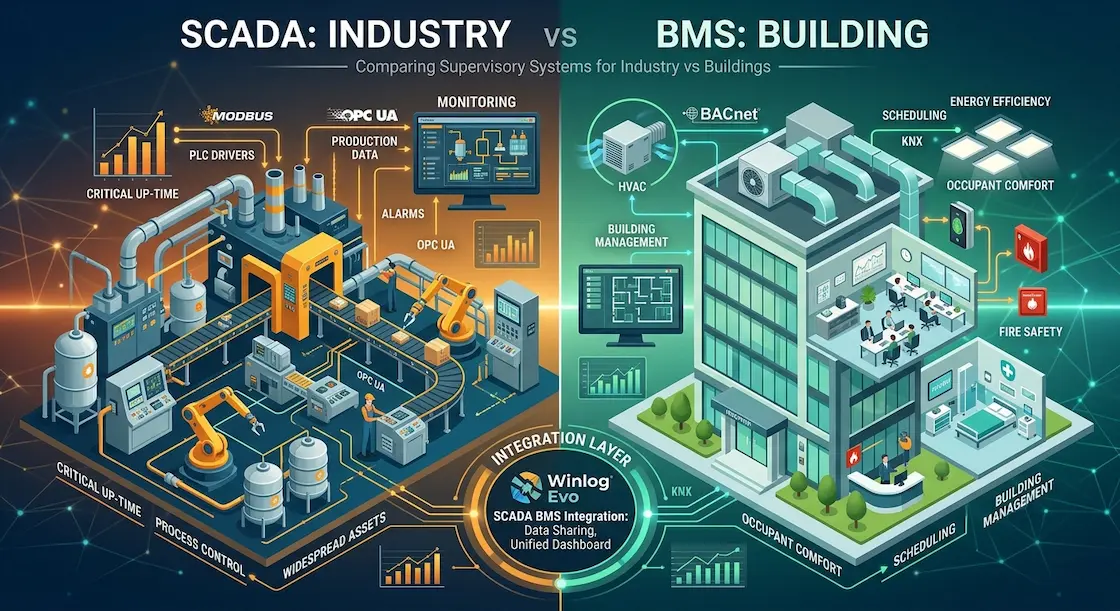
The clearest way to compare SCADA for buildings against a BMS is by goal: SCADA exists to supervise industrial or infrastructure processes — production lines, water networks, energy grids — where uptime, throughput and safety are the priorities, while a BMS exists to keep a building comfortable and efficient for its occupants. Scale differs too: SCADA is commonly deployed across large, geographically distributed sites with many different protocols (Modbus, OPC UA, proprietary PLC protocols), while a BMS usually covers a single building or campus using a narrower, standardized protocol set. SCADA also tends to offer deeper historization, alarm management and reporting capabilities than a typical BMS, which is oriented more toward scheduling and setpoint control.
Cost structure differs as well: a BMS is often priced and licensed per building or per point count within a fairly fixed scope, whereas SCADA licensing usually scales with tags, drivers and client seats across a much broader and more variable set of assets, which is worth factoring into any budget comparison between the two.
When to choose BMS vs SCADA (decision criteria)
Use a BMS when the primary goal is managing HVAC, lighting and life-safety systems in a commercial building, and the protocols involved are BACnet or KNX. These are the most important BMS selection criteria to check before committing to a platform. Use SCADA when the site involves industrial processes, production equipment, energy infrastructure, or multiple buildings/sites that need centralized supervision with deep historization and alarm management. Many mixed-use sites — a factory with an adjoining office building, for instance — end up needing both, run as separate but occasionally interconnected systems.
A useful litmus test is to ask what happens if the system goes down for an hour: if the answer is mainly discomfort, a BMS is probably sufficient; if the answer involves lost production, safety risk or regulatory exposure, SCADA-grade supervision is the safer choice.
SCADA and BMS integration in complex sites
SCADA BMS integration becomes relevant on campuses or industrial sites where facility management and process supervision need to share data: energy consumption reporting that spans both production equipment and building HVAC, for example, or a single alarm dashboard covering both a chiller plant and a manufacturing line. A SCADA platform with native BACnet and KNX support, alongside its usual industrial communication drivers, can absorb both worlds into one supervisory layer instead of forcing operators to switch between two disconnected systems.
This integrated approach is increasingly common in industries where energy cost is a major line item, such as food processing or pharmaceuticals, where site managers want a single view of total energy consumption regardless of whether it was drawn by a production line or an air handling unit.
Not sure whether your site needs SCADA, BMS, or both? Try the Winlog Evo web demo, check the supported protocols, or contact Sielco Sistemi for guidance.
FAQ
- What is the main difference between SCADA and a BMS?
- SCADA exists to supervise industrial or infrastructure processes where uptime, throughput and safety are the priorities, while a BMS exists to keep a building comfortable and energy-efficient for its occupants using protocols such as BACnet and KNX.
- Which protocols does a typical BMS use?
- A BMS typically speaks building-specific protocols such as BACnet and KNX, a narrower and more standardized set than the many industrial protocols (Modbus, OPC UA, proprietary PLC protocols) that a SCADA system usually needs to support.
- When is a BMS enough and when do I need SCADA?
- A BMS is enough when the goal is managing HVAC, lighting and life-safety in a single commercial building. SCADA is needed when the site involves industrial processes, production equipment, energy infrastructure, or multiple sites needing centralized supervision.
- Can SCADA and BMS be integrated on the same site?
- Yes. A SCADA platform with native BACnet and KNX support, alongside its industrial communication drivers, can absorb both worlds into one supervisory layer, which is common on campuses where facility management and process supervision need to share data.
- How do BMS and SCADA licensing costs typically differ?
- A BMS is often priced per building or per point count within a fairly fixed scope, whereas SCADA licensing usually scales with tags, drivers and client seats across a much broader and more variable set of assets.