SCADA and ICS cybersecurity: vulnerabilities, testing and guidelines
Sielco Sistemi —
SCADA cybersecurity is the discipline of protecting the industrial control systems that monitor and operate plants, utilities and critical infrastructure from unauthorized access, tampering and disruption. As SCADA platforms increasingly connect to corporate IT networks, cloud services and remote maintenance tools, the attack surface facing operators has grown far beyond the isolated, air-gapped systems of decades past. Solid SCADA security combines technical hardening, disciplined testing and adherence to recognized frameworks. Winlog Evo, the SCADA/HMI platform from Sielco Sistemi, is built with these requirements in mind and serves as the reference SCADA throughout this guide.
SCADA vulnerabilities and hardening
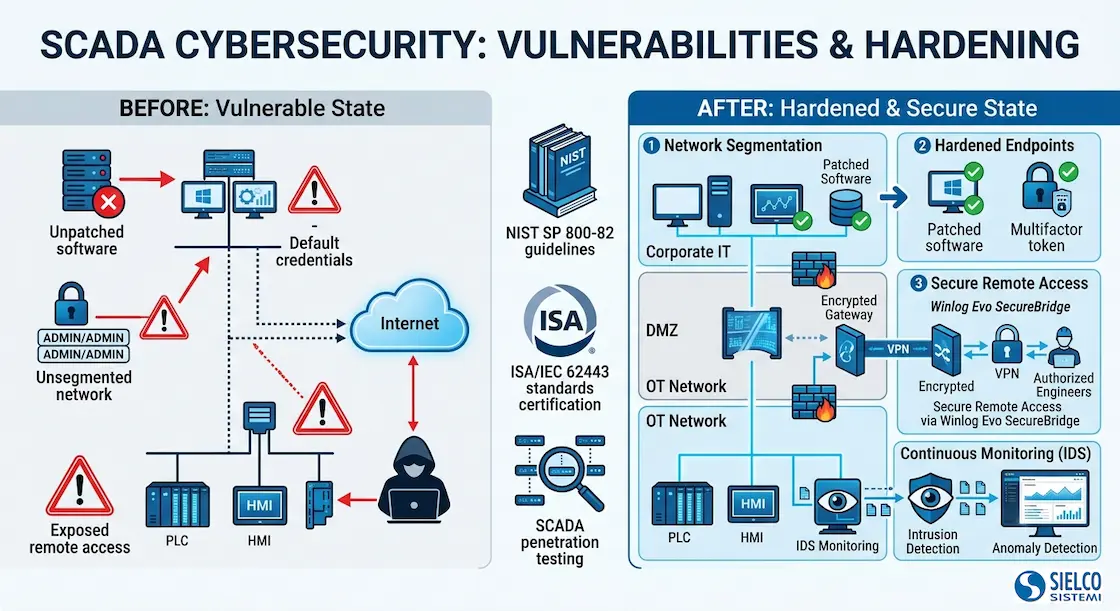
Most SCADA vulnerabilities stem from legacy protocols with no built-in authentication, unpatched software, default or shared credentials, flat networks with no segmentation between IT and OT, and remote access left open without proper controls. A single unaddressed vulnerability in an exposed PLC or a poorly configured gateway can give an attacker a path from the internet all the way to physical equipment. This is why ICS and SCADA security has to be treated as an ongoing program, not a one-time checklist.
Hardening starts with the basics: segment OT networks from IT and the internet using firewalls and demilitarized zones, remove or disable unused services and ports, replace default credentials, patch operating systems and SCADA software on a defined schedule, and enforce role-based access with logging. Secure remote access is especially critical: a module such as Winlog Evo SecureBridge lets maintenance staff and integrators connect without exposing SCADA servers directly to the public internet, which closes one of the most common entry points attackers exploit against industrial networks.
SCADA penetration testing
SCADA penetration testing validates hardening decisions by actively probing a control system the way an attacker would, but under controlled conditions that avoid disrupting production. A penetration test for an industrial environment typically starts with passive reconnaissance and asset discovery before moving to more active checks, because many field devices are fragile and can misbehave under aggressive scanning that would be harmless against ordinary IT servers.
Tools such as Nmap are commonly used for the discovery phase; running nmap SCADA scans with conservative timing settings helps map exposed hosts, open ports and running services on the OT network without overwhelming sensitive equipment. Good practice pairs this network-level testing with a review of SCADA application configuration, user accounts and remote access paths, then documents findings against a recognized standard such as ISA/IEC 62443 so remediation can be prioritized and tracked over time, ideally by testers experienced with cybersecurity for SCADA systems rather than generic IT auditors alone.
NIST guidelines and frameworks
For organizations building or maturing a SCADA security program, established frameworks remove much of the guesswork. The NIST SP 800-82 guide to industrial control systems security is the most widely referenced reference document; NIST SCADA guidance covers network architecture, risk management and specific countermeasures tailored to the constraints of control environments, where availability and safety take precedence over the confidentiality priorities typical of office IT.
Alongside NIST, the CISA ICS security program publishes advisories on active threats and known vulnerabilities affecting specific vendors and products, while the International Society of Automation maintains the ISA/IEC 62443 series of standards used to certify components, systems and processes. Combining NIST’s risk-based guidance with ISA/IEC 62443’s certification structure and CISA’s real-time advisories gives plant operators a practical, layered basis for prioritizing hardening work rather than trying to fix everything at once.
IDS for SCADA networks
Hardening and testing reduce risk, but continuous monitoring is what catches the incidents that slip through anyway. An intrusion detection system deployed on the OT network watches traffic passively and flags anomalies, such as an unexpected connection attempt, an unfamiliar protocol command, or a device communicating with a host it has never talked to before, without interfering with real-time control traffic.
A well-tuned SCADA IDS is particularly valuable because industrial traffic patterns are usually far more predictable than office network traffic, which makes deviations easier to spot with fewer false positives once the baseline is established. Pairing IDS monitoring with secure remote access through Winlog Evo SecureBridge and with the broad list of supported device drivers gives operators visibility across both the network layer and the SCADA application layer, closing the loop between detection and response.
Ready to see how Winlog Evo supports a hardened, monitored SCADA architecture? Try the Winlog Evo web demo, review the communication drivers, or contact Sielco Sistemi to discuss your project.
FAQ
- What are the most common SCADA vulnerabilities?
- Legacy protocols with no built-in authentication, unpatched software, default or shared credentials, flat networks with no IT/OT segmentation, and remote access left open without proper controls are the most common causes of SCADA vulnerabilities.
- How does SCADA penetration testing differ from regular IT pentesting?
- SCADA penetration testing must account for fragile field devices that can misbehave under aggressive scans, so it typically starts with passive reconnaissance and uses conservative, carefully timed active tests instead of the more intensive methods common in ordinary IT environments.
- Is it safe to use nmap SCADA scans on a live production network?
- It can be, but only with conservative timing settings and careful scope control, since aggressive scanning that is harmless on ordinary IT servers can disrupt fragile field devices; conservative, well-planned Nmap scans are the recommended approach for discovery on OT networks.
- What does NIST SP 800-82 cover for SCADA and ICS security?
- NIST SP 800-82 is the most widely referenced guide to industrial control systems security, covering network architecture, risk management and countermeasures tailored to control environments where availability and safety take precedence over the confidentiality priorities typical of office IT.
- Why is an IDS useful on a SCADA network if firewalls are already in place?
- Firewalls block known bad traffic at the perimeter, but an IDS passively monitors what happens inside the OT network and flags anomalies such as unexpected connections or unfamiliar protocol commands, catching incidents that slip past segmentation and access controls.