SCADA programmer and SCADA developer: role, skills and career path
Sielco Sistemi —
A SCADA programmer — often called a SCADA developer — designs and configures the software that lets operators supervise, control and record data from industrial plants: process graphics, tag databases, alarms, trends and reports. The role sits at the intersection of automation, IT and process knowledge, working daily on platforms such as Winlog Evo to turn raw field signals into usable operator screens and plant history. Unlike a general software developer, a SCADA programmer must understand both the physical process being supervised and the constraints of industrial networks and hardware. This guide covers the skills, tools, training and career paths that define the profession, from first junior configuration tasks through senior integration and management roles.
Skills: PLCs, HMI and electrical grids
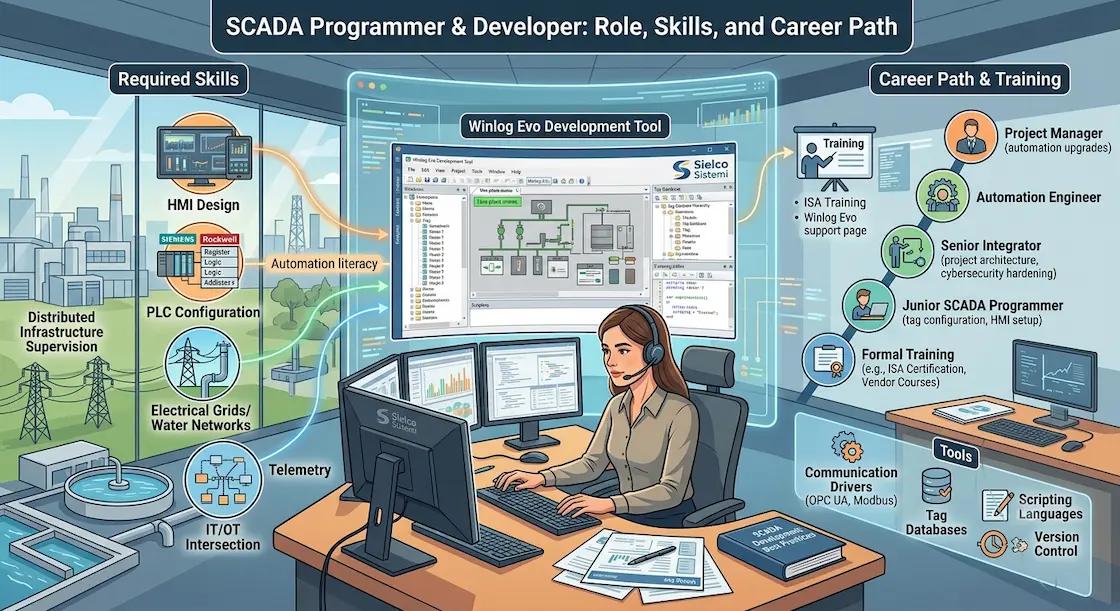
A competent SCADA programmer needs working knowledge of PLCs (programmable logic controllers), since almost every SCADA project starts by reading and writing data to controllers from vendors such as Siemens or Rockwell Automation. Understanding ladder logic, register addressing and PLC scan cycles makes it far easier to design tag structures that map cleanly onto the controller’s memory.
Equally important is fluency in HMI design: building screens that communicate plant state at a glance, prioritizing alarms correctly and avoiding clutter that slows operator response during an upset. Many SCADA developers also work on or around electrical grids, water networks and other distributed infrastructure, where telemetry, redundancy and cybersecurity concerns add another layer of required expertise beyond a single factory floor. Basic electrical and instrumentation literacy — reading wiring diagrams, understanding analog and digital signal types, and recognizing common sensor and actuator behavior — rounds out the technical foundation that separates a productive SCADA programmer from one who can only follow a template.
Development tools and methods
Beyond controller knowledge, a SCADA developer needs to be comfortable inside a dedicated development environment: building a tag database, configuring communication drivers, scripting logic, and laying out graphic pages that update in real time. Platforms like Winlog Evo’s development tool provide exactly this environment — the tag database, driver library and scripting layer a SCADA programmer works in every day — so that projects can be built, tested and deployed without writing a supervisory system from scratch.
A strong grasp of communication drivers and protocols such as Modbus and OPC UA is essential, since most real-world time is spent connecting to and validating data from heterogeneous field devices, not writing screens. Version control, structured testing on a staging system, and disciplined naming conventions for tags and scripts round out the practical toolkit that separates a maintainable SCADA project from one that becomes unworkable as the plant grows.
SCADA training courses
Formal training for a SCADA programmer typically combines vendor-specific product courses with broader industrial automation education. Professional bodies such as the International Society of Automation (ISA) offer certification programs and courses covering control systems, instrumentation and industrial cybersecurity that are widely recognized across the sector and provide a structured path into the field for engineers moving from IT or electrical backgrounds.
On top of that foundation, hands-on training with the actual SCADA platform matters: working through the documentation and examples on the Winlog Evo support page, then practicing on a real or trial project, builds the specific configuration skills that generic courses cannot. Many SCADA developers also learn through mentored on-the-job projects, shadowing an experienced integrator on commissioning visits before taking ownership of a project independently.
SCADA jobs: roles and career paths
SCADA jobs span a wide range of titles and responsibilities: SCADA developer, SCADA programmer, systems integrator, controls engineer, automation engineer and plant IT specialist all touch supervisory software at some point. Entry-level roles usually focus on configuring tags, screens and reports under supervision, while senior roles take on architecture decisions, cybersecurity hardening and coordination between plant control networks and corporate IT.
Career progression often moves from a systems-integrator role — implementing SCADA projects for multiple clients across industries — toward a specialized in-house position at a single utility, manufacturer or infrastructure operator, or toward project management overseeing full automation upgrades. Because SCADA sits at the center of plant visibility, experienced developers are consistently in demand across manufacturing, water and wastewater, energy and building automation, making it one of the more resilient specializations within industrial automation. Freelance and contract SCADA jobs are also common, since many small and mid-sized plants need project-based expertise rather than a full-time in-house developer.
Ready to start building SCADA skills? Try the Winlog Evo web demo, explore the communication drivers library, or contact Sielco Sistemi to discuss training and integration support.
FAQ
- What does a SCADA programmer actually do day to day?
- A SCADA programmer builds tag databases, configures communication drivers to PLCs and field devices, designs HMI screens and alarms, writes scripting logic, and tests and deploys supervisory projects such as those built on Winlog Evo.
- Do I need to know PLC programming to become a SCADA developer?
- Not necessarily as a programmer of the PLC itself, but a SCADA developer must read PLC logic, registers and scan cycles well enough to map data correctly into tags, so at least working familiarity with ladder logic and addressing is expected.
- What certifications or courses are recognized for SCADA training?
- The International Society of Automation (ISA) offers widely recognized certification programs covering control systems, instrumentation and industrial cybersecurity, which pair well with hands-on, platform-specific training such as the documentation and examples on the Winlog Evo support page.
- What SCADA jobs and career paths can I pursue after training?
- Titles include SCADA developer, SCADA programmer, systems integrator, controls engineer and automation engineer; careers typically progress from integrator or junior configuration roles toward specialized in-house positions, project management, or freelance and contract SCADA work.
- Which industries have the most demand for SCADA developers?
- Manufacturing, water and wastewater treatment, energy and electrical grid operators, and building automation consistently need SCADA developers, since supervisory visibility over distributed equipment is central to operating any of these infrastructures reliably.